
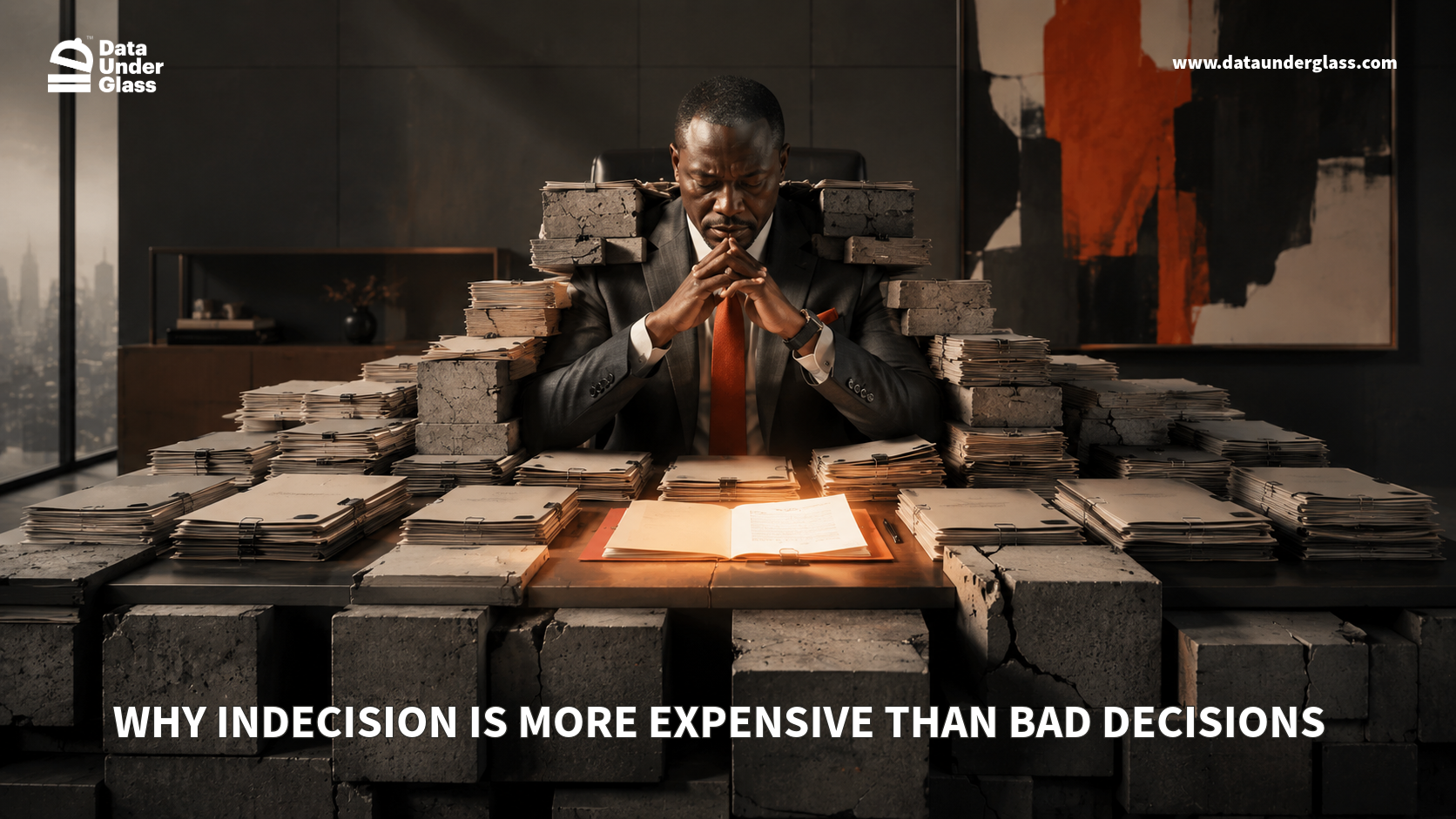
Every founder has a decision sitting in their inbox that they keep calling “strategic patience.”
Fire the underperformer.
Kill the product nobody uses.
Approve the hire.
Exit the market.
Change the pricing.
Replace the executive.
The story is always the same: Let’s wait for more data.
But sometimes you are not buying insight.
You are buying time, and the time has a huge bill.
From The Operator’s Desk
What Leadership Believes
Delaying a hard operational choice buys time to collect better data, hedges downside risk, and keeps options open until conditions clarify.
What Actually Happens
An unresolved decision doesn’t sit passively in the background. Research on unfulfilled goals found that an open commitment stays cognitively “live”, it produces intrusive thoughts during unrelated work and measurably worsens performance on other tasks, right up until the person either finishes it or commits to a concrete plan for finishing it. Notably, the plan itself, not completion, is what quiets the loop (Masicampo & Baumeister, Journal of Personality and Social Psychology, 2011).
At the organizational level, McKinsey’s global survey of executives on decision-making found that a majority report their decision-making time is used ineffectively, and only one in five say their organization genuinely excels at making decisions. McKinsey calculated that inefficient decision-making costs a typical Fortune 500 company roughly 530,000 days of managerial time a year, about $250 million in wasted labor.
The Reality
The stakes aren’t abstract. Bain & Company’s research across nearly 800 companies found a 95% correlation between organizations that excel at making and executing decisions and those that deliver top-tier financial performance, measured in revenue growth, return on capital, or total shareholder return. Decision quality isn’t a soft metric. It’s a leading indicator of the hard ones.
The Lesson
Indecision is not caution. It’s an unpriced liability sitting on the executive balance sheet, one that compounds the longer it goes unresolved.
The Evidence Stack
- Majority / only 1 in 5: Share of executives who call their decision-making time inefficient, versus the share who say their organization excels at it (McKinsey).
- ~530,000 days / ~$250M: Annual managerial time and wage cost a typical Fortune 500 company loses to inefficient decision-making (McKinsey).
- 95%: Correlation between decision effectiveness and top-tier financial performance across companies studied (Bain & Company).
- Plan-as-closure: Committing to a concrete plan for an unfinished goal, not completing it, is what eliminates the cognitive drag it creates (Masicampo & Baumeister, 2011).
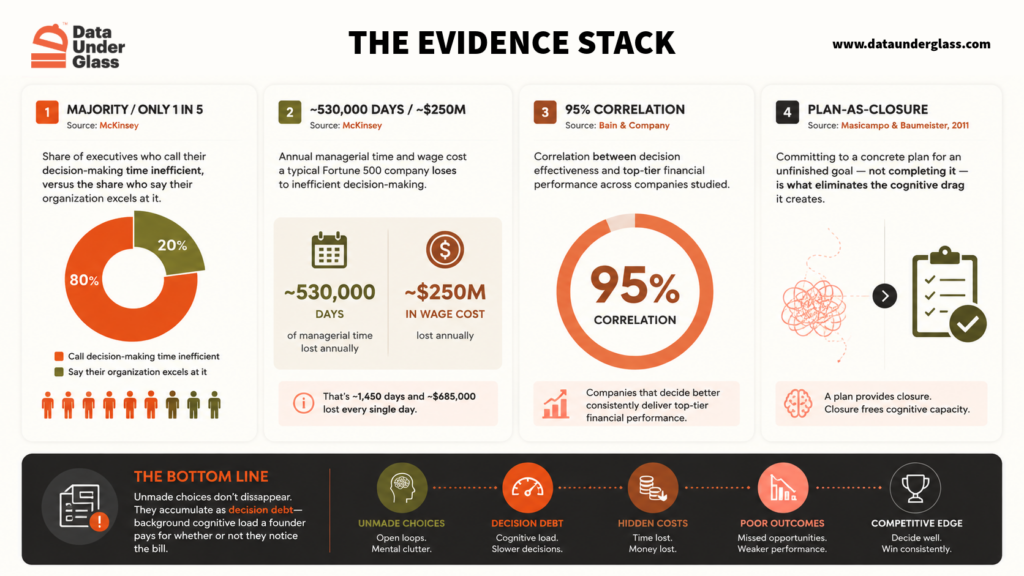
Unmade choices don’t disappear. They accumulate as decision debt, background cognitive load a founder pays for whether or not they notice the bill.
Flagship Insight: The Selection Bias Distortion
The Working Memory Tax. Every open decision behaves like a running process the brain won’t close. The more a founder hoards, the less bandwidth remains for the choices that actually require judgment.
The Optionality Illusion. Waiting feels like risk management. The evidence says otherwise: an unresolved choice imposes a cost from the moment it’s opened, regardless of whether the eventual answer changes.
The Delegation Vacuum. When a founder sits on a decision, direct reports can’t act around it. Ambiguity at the top freezes execution below it, not because teams lack initiative, but because they lack the authority to fill the gap.
What’s Actually Working
- Force binary resolution. Every open item gets a yes/no/delegate decision on a fixed date, no indefinite “still thinking about it.”
- Put the backlog on the dashboard. Track open-decision count next to burn rate and revenue. What gets measured gets cleared.
- Run a weekly clearance session. A standing meeting whose only job is closing out anything that’s sat longer than two weeks.
Steal This: The Demand Reality Audit
Decision debt doesn’t come from making difficult decisions. It comes from leaving decisions unresolved.
1. The Working-Memory Tax: Every open decision consumes some amount of attention. One isn’t a problem. Twenty-seven is an operating system. A founder who keeps mentally revisiting pricing, hiring, product priorities, an executive’s performance, and three unresolved market questions is carrying a private backlog that doesn’t appear on the company’s balance sheet. But the company still pays for it.
2. The Optionality Illusion: Waiting can be useful when new information has a reasonable chance of changing the decision. But that’s not always what is happening. Sometimes the information required to make the decision is already available. The founder simply doesn’t like what it implies.
So the decision gets renamed:
“Let’s monitor it.”
“Let’s give it another month.”
“Let’s see what Q4 looks like.”
“Let’s gather more data.”
At some point, information gathering stops being analysis and becomes avoidance.
3. The Delegation Vacuum: This is where decision debt becomes operational debt. When leadership refuses to decide, teams don’t automatically become more autonomous. They often become more conservative. People stop acting because they don’t know which direction leadership will eventually choose. The founder thinks they’re keeping options open. The team experiences it as a lack of authority. .
Field Intelligence
Signal
- Open-decision count tracked as an operating metric.
- Fixed resolution windows for non-urgent choices.
- Authority pushed down, not held at the top.
Noise
- Calling chronic indecision “strategic patience.”
- Treating decision fatigue as an inevitable cost of scale.
- Waiting for “perfect” data on decisions that don’t require it.
The Bottom Line
Summary: Every unmade decision accumulates as debt, a cognitive and organizational drag with a measurable link to financial performance.
Reality: Operators who force resolution outperform. The research isn’t ambiguous on this point.
Hard Truth: If you’ve been “thinking about” the same decision for three weeks, you’re not being careful. You’re the bottleneck.