

For the last decade, some of the most celebrated startup stories in Nigeria and Canada shared the same flaw: they scaled on trust before proving demand.
54gene raised over $45M and became a flagship African biotech story, but never built a commercial market to match the narrative. QuadrigaCX rode founder credibility until operational weaknesses surfaced, the company collapsed, locking customers out of millions. Edukoya closed one of Africa’s largest pre-seed rounds at $3.5M, then hit the wall of weak purchasing power and entrenched offline habits. Wattage generated attention that never converted to repeatable demand.
Different sectors, different countries, different reasons, but same mistake. Each exposed similar dangerous habit: treating early attention, relationships, or founder credibility as stronger evidence of a durable business than the underlying market actually provided.
CRV’s 2026 PMF guide identifies this directly: early traction created by the founder’s personal network looks like product-market fit but is actually founder-market fit, and true PMF only reveals itself when sales cycles shorten without founder involvement. Bessemer Venture Partners is equally direct: separate experimental ARR driven by pilots from durable ARR driven by recurring, usage-based, or contractual commitments, or you will misread the signal entirely.
From The Operator’s Desk
Case in Point: In Q2 2025, a Toronto-based HR compliance platform expanding across the Toronto–Lagos corridor raised a $2.1M seed round on the strength of a 94 NPS from 11 pilot customers. The problem? Every pilot customer came from the founder’s professional network. When the first 40 organic customers arrived, NPS fell to 38, conversions slowed, and month-6 churn reached 31%.
What Broke:
- The Network Distortion: Pilot NPS of 94 came from founder-network users whose personal loyalty masked structural product gaps that cold-market users would immediately surface.
- The Organic Collapse: The first 40 organic post-seed customers converted at a 38 NPS—a 56-point gap from the pilot score—once cold workflow friction hit without relationship insulation.
- The Retention Bleed: Month-6 churn spiked to 31% as un-networked users abandoned broken operational flows the pilot cohort had forgiven.
- The Capital Trap: Seed capital was deployed into broad acquisition before the core product could survive unassisted market contact.
The Reality:
Product-Market Fit had been measured on a selection effect, not a market signal, masking structural product deficiencies behind personal loyalty. The investor deck was accurate. The cohort data was not representative.
The Lesson:
A pilot customer is not a market. They are a relationship. Never fund your operating model on borrowed goodwill.
The Evidence Stack
- 40%+: “very disappointed” users, the validated PMF threshold (Bessemer Venture Partners/Sean Ellis methodology)
- 94 → 38 NPS: 56-point NPS collapse from pilot to first organic cohort, Toronto HR platform, Q2 2025 operator case
- 31%: Month-6 churn among first organic cohort after seed deployment, same operator, same period
- Pilot purgatory: A product in “enterprise pilot purgatory” generates enthusiastic pilots with no conversion to multi-year contracts; the structural failure of measuring PMF on forgiving early cohorts (PM Toolkit, 2026)
- If your network cohort retains meaningfully better than your organic cohort, you’re not looking at demand, you’re looking at goodwill.
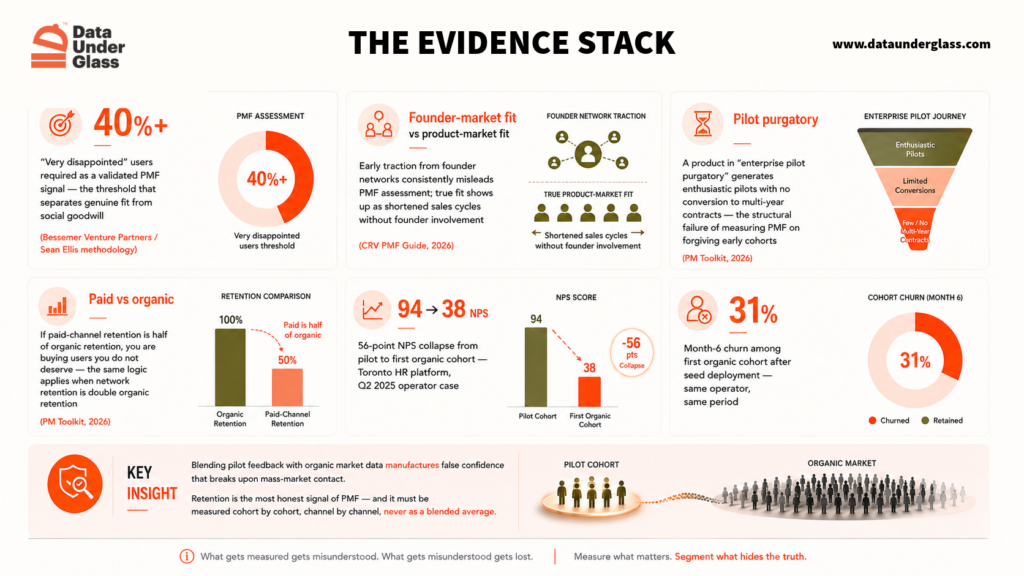
Blending pilot feedback with organic market data manufactures false confidence that breaks upon mass-market contact. Retention is the most honest signal of PMF—and it must be measured cohort by cohort, channel by channel, never as a blended average.
Flagship Insight: The Selection Bias Distortion
When founders recruit initial users from their professional or diaspora networks, they harvest artificial validation rather than scalable commercial demand. Three mechanisms drive the distortion.
1. The Forgiveness Shield
Pilot users tolerate broken workflows because personal rapport masks product gaps. They complete tasks through workarounds they would never accept as strangers. They score the product on the relationship, not the experience. CRV notes this directly: founders build for their most engaged power users, whose atypical needs and enthusiasm create survivorship bias in product decisions, and whose tolerance creates survivorship bias in PMF signals. The NPS is real. The market it represents is not.
2. The Diaspora Echo Chamber
Across cross-border corridors like Toronto and Lagos, diaspora-network pilot customers carry cultural familiarity and personal trust that cold-market enterprise buyers do not. Their willingness to overlook friction, wait for fixes, and advocate internally is structurally higher than the actual addressable market—producing retention and satisfaction signals that are impossible to replicate at scale. Expansion strategies built on this cohort are built on an edge case, not a segment.
3. The Premature Scaling Trap
Raising capital on selection-bias metrics accelerates acquisition spend before the product can survive unassisted cold-market contact. Bessemer identifies the discipline that prevents this: separating experimental ARR from durable ARR, revenue from pilots and novelty spikes versus revenue from recurring contractual commitments. The Toronto platform had experimental ARR dressed as durable ARR in its seed deck. The organic cohort exposed the gap at month 6.
What’s Actually Working
1. Demand Validation Before Capital Deployment
Before raising growth capital, build a meaningful cold-market cohort large enough to compare against your network cohort. Track their retention, NPS, and referral rate independently. If that cohort’s performance is materially worse than the network cohort, the network cohort is not market evidence; it is social evidence. Do not scale based on social evidence.
2. Audit Structural Market Readiness
Before entering a market, particularly in West Africa, independently verify whether the infrastructure required for recurring product usage actually exists at the scale required. Edukoya’s failure was not strategic. It was a market audit that was never conducted. Connectivity, device penetration, disposable income, and consumer behavioral preference for the delivery model are all verifiable before the first dollar is raised. Verify them.
3. Separate Durable ARR from Experimental ARR
Bessemer’s discipline is non-negotiable: pilot revenue, network-sourced revenue, and novelty-driven usage are experimental ARR. Recurring, contractual, usage-based commitments from cold-market customers are durable ARR. Report them separately in every investor update and internal dashboard. Blending them manufactures a number that is mathematically accurate and strategically misleading.
What’s Actually Working
1. Demand Validation Before Capital Deployment
Before raising growth capital, isolate a cohort of minimum 25 customers who had no prior relationship with the founding team and could not name the founder before purchase. Track their retention, NPS, and referral rate independently. If that cohort’s performance is materially worse than the network cohort, the network cohort is not market evidence, it is social evidence. Do not scale on social evidence.
2. Audit Structural Market Readiness
Before entering a market, particularly in West Africa, independently verify whether the infrastructure required for recurring product usage actually exists at the scale required. Edukoya’s failure was not strategic. It was a market audit that was never conducted. Connectivity, device penetration, disposable income, and consumer behavioural preference for the delivery model are all verifiable before the first dollar is raised. Verify them.
3. Separate Durable ARR from Experimental ARR
Bessemer’s discipline is non-negotiable: pilot revenue, network-sourced revenue, and novelty-driven usage are experimental ARR. Recurring, contractual, usage-based commitments from cold-market customers are durable ARR. Report them separately in every investor update and internal dashboard. Blending them manufactures a number that is mathematically accurate and strategically misleading.
Steal This: The Demand Reality Audit
1. The Cold Cohort Test: Remove every customer who knew you personally before they purchased. What is the NPS, churn rate, and referral rate of what remains? If those numbers are materially worse, you have founder-market fit — not product-market fit.
2. The Infrastructure Audit: For every market in your expansion thesis, independently verify that the physical and economic infrastructure required for recurring product usage exists today — not in a five-year projection. Connectivity, device access, purchasing power, and delivery-model preference are all auditable before launch.
3. The Single-Point-of-Failure Map: Identify every function in your business that depends entirely on one person’s relationships, access, or knowledge. QuadrigaCX had one. It had no business underneath. Map yours and build institutional redundancy before it becomes a collapse event.
4. The ARR Split: Separate your revenue into experimental and durable columns in your next board update. If the durable column is smaller than the experimental column, you are presenting the wrong number as proof of traction.
Field Intelligence
Signal
- Validating organic cold-market cohorts before declaring PMF or raising growth capital
- Auditing physical and economic infrastructure before entering African consumer markets
- Separating experimental and durable ARR in all investor and board reporting
- Building institutional redundancy around every single-point-of-trust dependency
Noise
- Treating founder pedigree and media coverage as proxies for market demand
- Blending network-sourced and organic customer metrics into a single headline NPS
- Assuming infrastructure readiness in emerging markets without independent verification
- Centralising operational trust in a single founder without governance redundancy
The Bottom Line
Hype raises capital. It does not build businesses. Pedigree opens doors. It does not create recurring demand. The corridor between founder reputation and genuine product-market fit is where most venture-backed companies quietly collapse, and it is almost never visible in the deck that closed the round.
The provocative reality: 54gene, Edukoya, and QuadrigaCX were not failures of ambition. They were failures of demand validation, capital deployed at scale before anyone confirmed that the market, the infrastructure, or the governance could support what was being built.
The hard truth: If your best customers are people who trust you personally, you haven’t validated a market — you’ve validated your address book. The market has no idea who you are.