

In the late 1990s, Dow Corning watched its silicone business slide toward commoditization. Margins fell across the industry as a growing block of price-sensitive buyers pulled every competitor toward the same number. The instinct, match the discounts, keep the broad pitch, is the instinct most operators reach for today. It was also the wrong one. Dow Corning protected its margin not by sounding more appealing to everyone, but by splitting its offer in two: a stripped-down, no-frills brand (Xiameter) for price-driven buyers, and a distinctly positioned premium brand for everyone else. The split, not the broader appeal, is what saved the business.
From The Operator’s Desk
What Leadership Believes
A single, broad value proposition, “fast, reliable, affordable”, covers the widest possible buyer set and maximizes pipeline.
What Actually Happens
Buyers stopped being able to tell one vendor from the next. A Gartner survey of more than 1,100 B2B customers found that 64% cannot distinguish one supplier’s digital experience from a competitor’s. When five vendors say the same three words, differentiation hasn’t quietly failed, it has already failed.
McKinsey’s research on B2B branding reinforces why this matters more than founders assume, decision-makers treat a supplier’s brand and positioning as a central, not marginal, input into the purchase decision, alongside product and price. Strip out the differentiation, and you haven’t removed a variable from the buyer’s decision, you’ve collapsed it down to the one variable you don’t control.
The Reality
When messaging sounds identical across a category, buyers don’t do extra work to find hidden differences, they default to the cheapest option that clears the bar. That default isn’t a buyer failure. It’s a rational response to a seller who declined to give them anything else to evaluate.
The Lesson
Broad messaging doesn’t expand a market. It donates margin to whichever competitor cuts price first. Specificity isn’t a restriction on addressable market size. It’s the prerequisite for pricing power.
The Evidence Stack
- 64%: Share of B2B customers who cannot distinguish one supplier’s digital experience from a competitor’s (Gartner).
- 8.7%: Increase in operating profit generated by a 1% price increase with no loss of volume, the size of the prize a defensible position protects, and what a broad, undifferentiated pitch quietly forfeits every time a rep discounts to “stay competitive” (McKinsey & Company).
- Brand and positioning are central, not cosmetic, to B2B purchase decisions: not a secondary input to price and product (McKinsey).
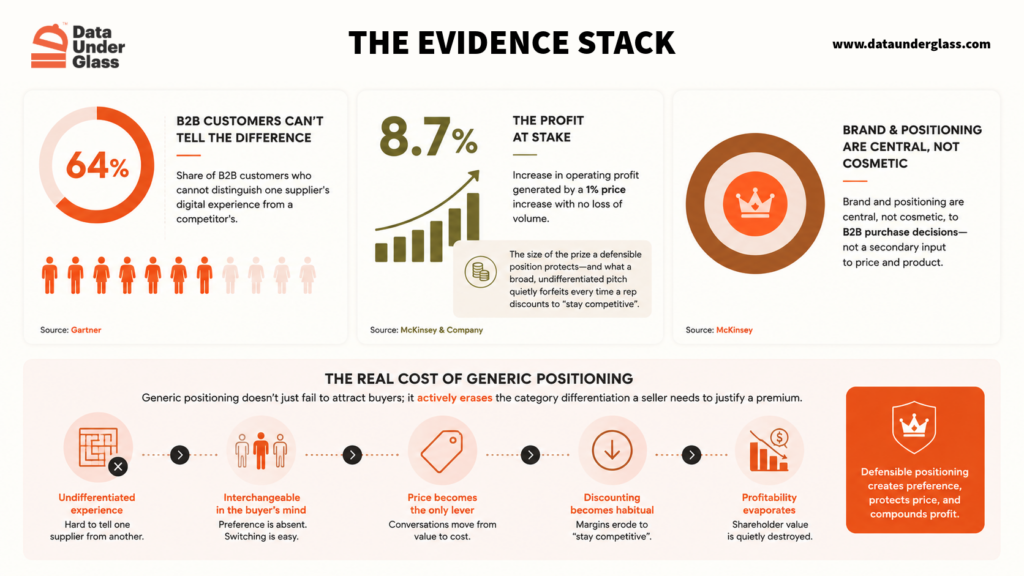
Generic positioning doesn’t just fail to attract buyers, it actively erases the category differentiation a seller needs to justify a premium. This succeeds at making every vendor interchangeable, and interchangeable vendors compete on nothing but price.
Flagship Insight: The Selection Bias Distortion
The mechanism traces back to Michael Porter’s foundational work on competitive strategy: once buyers perceive no meaningful difference between suppliers, competition collapses onto the one variable left standing, price. Catch-all messaging doesn’t prevent that collapse. It accelerates it, because “fast, reliable, affordable” is now every vendor’s headline, not a differentiator.
The Cognitive Default Buyers facing several vendors that all claim the same three adjectives don’t do the work of finding nuance. They default to the easiest variable to compare across five open browser tabs: price.
The Price Default Once price becomes the deciding variable, every sales call becomes a negotiation, and every negotiation trades away the margin a real position would have protected.
The Margin Compounding Because price moves profit out of proportion to itself, a discount conceded to “look competitive” costs far more than the single deal it appears to save
What’s Actually Working
- Run blind positioning audits: Strip the brand name from the homepage and hand it to someone in the target buyer segment. If they can’t tell it’s yours, a competitor’s copy would fit just as well.
- Segment before you message: Dow Corning didn’t out-market its category, it split the buyer base and built a distinct offer for each half.
- Defend price with proof, not appeal: Treat discounting as a last resort, not a negotiating opener, given how disproportionately price erosion compounds into lost profit.
Steal This: The Demand Reality Audit
Run the Homepage Erasure Test: Remove the logo and brand name. If a competitor’s copy could sit in its place, rewrite it.
Map the Top Four Competitors’ Headlines: Isolate and ban the buzzwords all four share.
Track Price-Concession Frequency: By rep and by deal, to find where positioning, not negotiation skill, is the real gap.
Interview the Last Five Closed-Lost Deals: Ask what specific capability the prospect believed was missing.
Field Intelligence
Signal
- Anchoring the homepage on one verifiable, hard-to-copy outcome.
- Running blind-swap tests on sales collateral before every major campaign.
- Segmenting price-sensitive buyers into a distinct offer instead of discounting the flagship product.
Noise
- Packing the homepage with adjectives every competitor also uses.
- Treating “fast, reliable, affordable” as a strategy rather than a description.
- Letting reps discount by default the moment a deal stalls.
The Bottom Line
Summary: When buyers can’t tell suppliers apart, they don’t reward the “safest” broad pitch, they shop on price, because price is the only thing left to compare.
Reality: Operators who narrow their claim to one verifiable outcome protect margin; operators who broaden it are quietly financing their competitors’ discounts.
Hard Truth: If a competitor could paste your headline onto their own homepage without changing a word, you’ve already lost the one thing that was ever going to protect your price.