.Read Time
A Toronto enterprise procurement firm spent seven months on a $3.8M West African pipeline before discovering that in 6 of 14 lost deals, the final decision was made by someone their team had never met. Forrester’s 2024 State of Business Buying found 86% of B2B purchases stall, not on price but on misidentified buying authority. In the Canada–Africa corridor, the average B2B deal now involves 13 stakeholders across multiple departments (Forrester, 2024). The one with the real veto is seldom the one who agreed to your demo.
From The Operator’s Desk
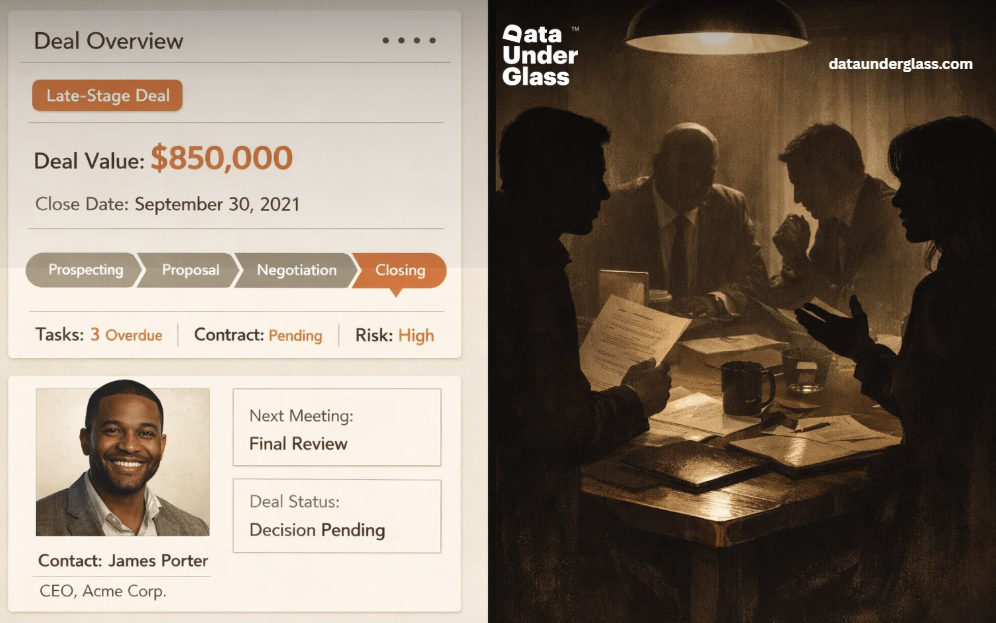
Case in Point: Q2 2024. Toronto enterprise procurement software firm. West African manufacturing targets. Standard motion: champion, demo, proposal to procurement. CRM: $3.8M late-stage. Deal age: 7 months.
What Broke:
- Stakeholder Inversion: The champion was a permission seeker with no budget authority and no political capital to close.
- The Invisible Veto: Post-mortems on 14 losses showed 11 champions weren’t final authorities. In 6 cases, the real decision-maker had never been contacted.
- CRM as Fiction: Deals sat late-stage while a second buying process ran entirely without the sales team.
The Reality: Win rate: 11% against an enterprise benchmark of 20–25% for deals above $100K. A stakeholder mapping gate extended the cycle by 14 days upfront and cut 47 days at close. Win rate hit 29% in two quarters.
The Lesson: Your CRM is a log of conversations with people who may not control the outcome. In West African enterprise markets, where trust networks and board-level uncles hold invisible veto authority, a deal that hasn’t reached those stakeholders isn’t late-stage. It’s a hallucination with a close date.
The Evidence Stack
- 86%: Of B2B purchases stall during the buying process; the leading cause is misidentified decision authority (Forrester, 2024)
- 13: Average number of stakeholders in a B2B purchase, 89% of which cross multiple departments (Forrester, 2024)
- 74%: Of B2B buying teams experience unhealthy internal conflict during the decision process (Gartner, 2025)
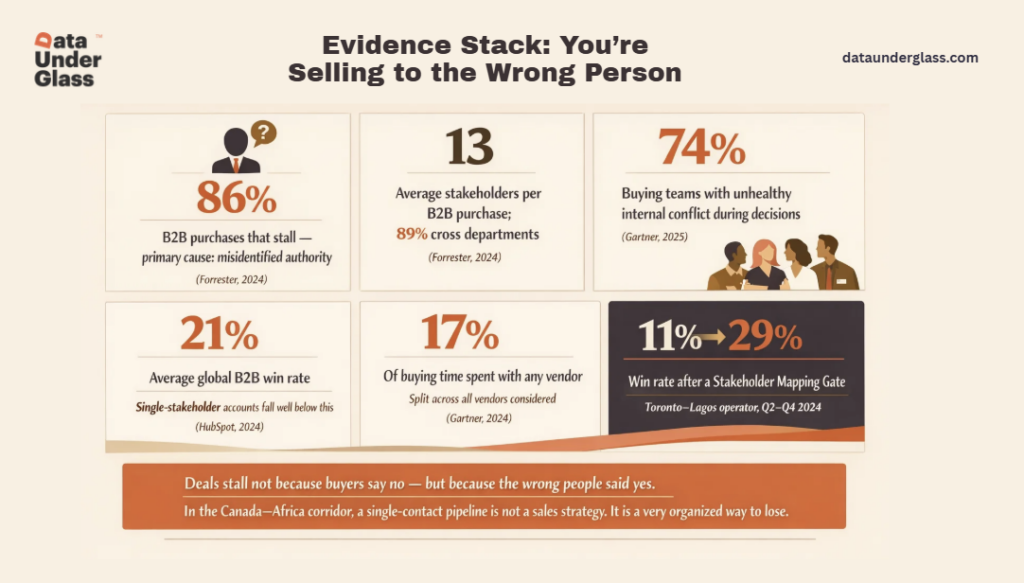
- 21%: Average B2B win rate globally; deals with only one identified stakeholder in the CRM typically fall well below this floor (HubSpot, 2024)
- 17%: Of total buying time that B2B buyers spend with any vendor, split across all vendors they’re evaluating (Gartner, 2024)
- 11% → 29%: Win rate improvement after implementing a stakeholder mapping gate. Toronto–Lagos operator, Q2–Q4 2024
Deals stall not because buyers say no, but because the wrong people said yes. In the Canada–Africa corridor, a single-contact pipeline is not a sales strategy. It is a very organized way to lose.
Flagship Insight: The Six Archetypes of the Invisible Committee
Before you send any proposal, find all six.
1. The User: Loves your product. Attends every demo. Cannot approve a single naira. Spending 90 days building rapport here without finding who’s above them is how deals die quietly.
2. The Champion: Wants to be the hero who brought you in. Rarely has the political muscle to push the deal through when it hits resistance. They’re your ally, not your decision-maker. Mistaking them for the economic buyer is the #1 reason “almost closed” deals go dark.
3. The Economic Buyer: Holds the budget. Cares about one thing: is this worth the risk? If you haven’t spoken to this person before sending a proposal, you’re pitching to the wrong room.
4. The Technical Buyer: Can’t say yes. Can absolutely say no at the finish line. In Toronto–Lagos deals, this is often a Canadian compliance team reviewing vendor contracts long after your champion declared the deal “done.”
5. The Informal Influencer: No title. No CRM entry. Absolute veto power. In West African enterprise, this is often a founder’s family member, a board elder, or a relationship-era “uncle.” They will never show up in your stakeholder map, and that’s exactly why deals that “looked done” disappear.
6. The Trust Underwriter: Usually the CFO or legal lead. Their only question: “If this vendor fails in 12 months, how bad do we look?” They appear late, raise objections that derail signed agreements, and get blamed for killing deals they were never invited into early enough. That’s on you, not them.
What’s Actually Working
1. The Stakeholder Mapping Gate: No demo or proposal until all six archetypes are documented, including the Informal Influencer. Adds 14 days at discovery. Removes 47 at close. Corridor operators moved from sub-15% to above 25% within two quarters.
2. The Trust Network Audit: For deals above $50K in West African markets, AEs must name at least one informal stakeholder before the late stage. In Lagos and Accra, this network makes or breaks the deal.
3. Multi-Thread From Day One: Three named contacts across archetypes before any account enters the pipeline. Gartner 2025: Committees reaching consensus are 2.5x more likely to call the outcome high-quality. Your job isn’t to sell to a champion. It’s to help a committee say yes.
Steal This: The Invisible Buyer Audit
1. The Single-Thread Test: Pull your top 10 late-stage deals. Count unique contacts per deal. Any deal above $50K with only one email in the CRM? Move it back to Discovery. One resignation. One political shift. Deal gone.
2. The Veto Holder Inventory: Ask your AE for every deal: “Who can kill this deal without appearing on the org chart?” Can’t name anyone? The account is under-mapped. In the Toronto–Lagos corridor, this is how you find the informal influencer, the person your Western sales process was never built to see.
3. The Dark Pipeline Diagnosis: Count deals that have been “late-stage” for 60+ days with no documented next step tied to a named decision-maker, not a champion. That number is your Invisible Committee tax. Every one of those deals is a relationship with someone who cannot say yes.
4. The Trust Underwriter Check: Has your CFO-equivalent or legal contact on the buyer side personally received your value case? Not forwarded by the champion, directly received. If the answer is no for any deal above $100K, your proposal is one internal review away from a veto you never saw coming.
Field Intelligence
Signal:
- Stakeholder Mapping Gate is required before any commercial proposal
- Informal Influencer mapping as a qualification criterion above $50K
- Trust Underwriter engagement is tracked as a pipeline health metric
Noise:
- Champion engagement score as the primary deal health signal
- Single-contact accounts advancing to late stages in email responsiveness
- Post-mortems that never ask who made the final call
The Bottom Line
Stop trusting champion engagement as a pipeline health measure. The most dangerous deal in your CRM has the highest engagement from the wrong person.
The provocative reality: Operators with stakeholder-mapping gates are closing at 29% in West African markets, while competitors wonder why win rates remain below 15%, not a better product. They found the room where the real decision was made.
The hard truth: Your prospect is a proxy, not a power; every deal they’re managing is one board meeting away from disappearing.