

Read Time
How does a Calgary energy analytics firm at $19M ARR watch its VP of Engineering resign and take half the engineering team, while quarterly culture scores sat above 7/10 and eNPS held at +42? For operators in the Canada–Africa corridor, treating employee satisfaction as a proxy for organizational health has become a primary driver of structural blindness. Mental Health America’s 2024 Workplace Wellness research found that 63% of workers don’t feel confident expressing their opinions at work. And Perceptyx’s 2025 benchmark data shows executives report 87% positive psychological safety perceptions, while individual contributors, the people closest to operational risk, report just 69%. The people who know what’s wrong are the most afraid to say it. Your satisfaction score is measuring the wrong thing entirely.
From The Operator’s Desk
Case in Point: Q1 2025, a Calgary-based energy data analytics company at $19M ARR was the darling of its Series B investors. Quarterly health scores above 7/10. eNPS at +42. Leadership believed culture was their greatest competitive weapon. “Our people are our greatest asset” found it’s way into every speech.
What Broke:
- Managed Harmony Trap: An implicit team-wide rule had calcified over 18 months, “don’t surface technical risks if they threaten a launch date.” Nobody wrote it. Everyone followed it.
- Invisible Debt Accumulation: Three previous product launches had been greenlit over major internal red flags. Each one passed. The team learned that silence worked.
- The Collection Event: A fourth launch, $2.1M in development, 60% complete, was being built on a foundation the engineering team privately knew was non-viable. The VP escalated once, was ignored, then resigned. Four of his eight direct reports followed.
- eNPS as Noise: The +42 score was real. It measured social comfort. It had nothing to say about whether the business was operationally sound.
The Reality:
The $2.1M product was halted. Stabilization cost $1.8M in direct spend and nine months of organizational focus. The founder’s conclusion: measuring whether people like working there is useless if they don’t feel safe telling you the truth.
The Lesson:
Culture debt works exactly like financial debt. Small, unresolved tensions don’t disappear, they compound. The Managed Harmony Trap produces organizations that are socially comfortable and operationally blind at the same time. The debt always collects. The market sets the due date.
The Evidence Stack
- 63%Of workers don’t feel confident expressing opinions at work (Mental Health America, 2024)
- 87% vs 69%Executives vs individual contributors reporting positive psychological safety, an 18-point gap at the exact layer where operational risk lives (Perceptyx, 2025)
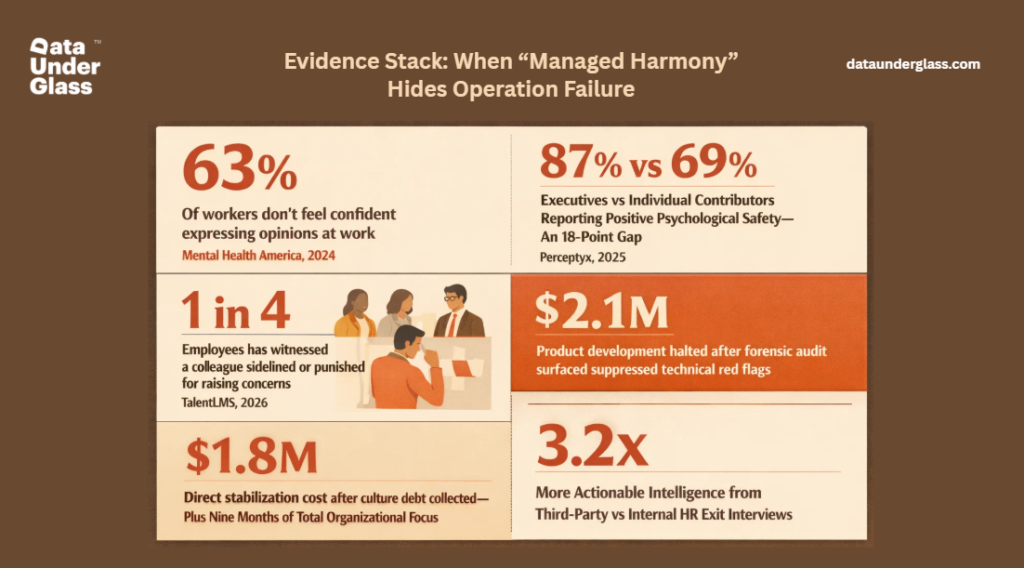
- 1 in 4Employees has witnessed a colleague sidelined or punished for raising concerns (TalentLMS, 2026)
- $2.1MProduct development halted after forensic audit surfaced suppressed technical red flags
- $1.8MDirect stabilization cost after culture debt collected, plus nine months of total organizational focus
- 3.2×More actionable intelligence from third-party vs internal HR exit interviews
Flagship Insight: The Seven Indicators of Culture Debt Accumulation
Strategic operators don’t measure happiness, they audit candor. In the Canada–Africa corridor, these seven behavioral signals mark when debt is compounding before it becomes a crisis.
1. “Nothing Is Wrong” Meetings
Every agenda item resolves cleanly in under ten minutes. No public disagreement. This is not alignment, it is performance.
2. The Performance Avoidance Loop
Underperformers stay in critical path roles because “the manager doesn’t want to hurt the vibe.” Every week that conversation is deferred, the debt compounds.
3. Late-Stage Blowups
Projects show green for months, then turn red 48 hours before launch. This is the signature of a team that learned escalating problems early is more dangerous than absorbing them quietly.
4. The Anonymous Survey Paradox
When the team only tells the truth anonymously, anonymity isn’t a feature, it’s the workaround built because the official channel isn’t safe. Your most actionable intelligence should not require a mask to reach you.
5. Corridor Silence
In the Toronto–Lagos corridor, Canadian founders routinely mistake polite silence from African operations teams for agreement. In many West African professional contexts, direct contradiction of a senior leader doesn’t happen in open settings. The veto is invisible, executing through delayed action and quiet non-compliance. You are not receiving alignment. You are receiving deference.
6. “Vibe” Over Value
Hiring for cultural fit, “who we’d have a beer with”, rather than cultural add, “who will challenge our blind spots.” These are the same problem wearing different hats.
7. Diligence Drift
Investor reference checks surface “organizational rot” the founder genuinely didn’t know existed. If due diligence is the first time you hear about a systemic leadership failure, your information architecture has already failed.
What’s Actually Working
1. Replace eNPS with Organizational Candor Assessments
Stop measuring whether people are happy. Measure whether bad news is traveling upward, and how fast. The question is not “do you enjoy working here?” It is “in the last 30 days, did you know something operationally important that you chose not to escalate?” The delta between those two answers is your candor gap.
2. Third-Party Forensic Exit Interviews
Internal HR curates exit feedback to protect its own metrics. Neutral third-party forensics surface 3.2× more actionable intelligence. When a VP departs, you have a 30-day window before institutional knowledge decays. Commission the external review immediately, not after you’ve “processed” the departure internally.
3. The 14-Day Rule
Performance issues must be documented and addressed within 14 days of discovery. Every day beyond 14 that a known issue sits unaddressed, the implicit organizational message becomes: “we tolerate this.” The $1.8M stabilization bill in Calgary was paid in installments of avoided conversations, each one cheap, collectively catastrophic.
Steal This: The Culture Debt Audit
1. The Empty Risk Register Test: Ask your Head of HR for every strategic or operational risk escalated by the team in the last 30 days. If the list is empty, the business isn’t risk-free, risk escalation has been learned to be unsafe. An empty register is the signature finding of the Managed Harmony Trap.
2. The Anonymous Channel Audit: What percentage of your most actionable intelligence last quarter arrived via anonymous surveys versus standing leadership meetings? If the ratio favors anonymous, you have a truth-suppression architecture, not a feedback problem.
3. The Late-Stage Red Count: How many projects in the last 12 months were green for 60+ days before turning red in the final two weeks? More than one is a pattern. It means your team has learned when to stay quiet and when it’s finally safe to escalate.
4. The Corridor Deference Check: In your last five Toronto–Lagos or Montreal–Accra leadership calls, did any member of your African operations team directly contradict a strategic position held by the Canadian side? If the answer is no, you’re not receiving candor. You’re receiving courtesy.
Field Intelligence
Signal
- Third-party forensic exit interviews surface 3.2× more intelligence than internal HR
- Organizational Candor Assessments replacing eNPS as primary health metric
- 14-day performance documentation rule reducing culture debt compounding
- Corridor deference dynamics now a documented risk factor in Canada–Africa operator diligence
Noise
- eNPS and satisfaction scores as primary organizational health indicators
- Assuming polite silence in cross-corridor calls equals strategic alignment
- Town halls and perks as the response to structural candor failure
- Treating VP departures as individual talent events, not debt collection signals
The Bottom Line
Stop reporting eNPS to your board as an organizational health indicator if you haven’t reconciled it against whether bad news is actually reaching you. In the Canada–Africa corridor, your satisfaction score is a social reading. Your candor gap is the only metric with strategic consequence.
The provocative reality: While competitors celebrate +42 eNPS and assume harmony equals health, operators who built candor-first reporting architectures surface $2.1M product risks in week two of development, not after the invoice arrives.
The hard truth: Your team already knows what is wrong. The only question is whether you’ve built a system where they can tell you.