
A Nairobi-founded agri-tech company built on extending credit to small retailers and running refrigerated warehouses for perishable stock. Twiga Foods raised more than $185 million over its lifetime, and in August 2026, it entered administration anyway. What failed wasn’t access to capital. It was assuming another round would outrun a cash leak that never got fixed.
Twiga Foods set out to fix a broken food supply chain, connecting farmers directly to the small retailers who fed Kenya’s cities. Investors bought the vision. Over its lifetime, Twiga raised $185.4 million. But moving food is expensive. Twiga had to buy produce, run warehouses and delivery fleets, manage spoilage, and wait for small retailers to pay. The cash demands kept mounting.
By 2023, suppliers were chasing overdue payments and the company was cutting hundreds of jobs. Then came a $35 million convertible bond in December 2023 to help stabilise the business and clear supplier arrears. Co-founder Peter Njonjo reportedly put in another $1 million of his own money.
The rescue bought time. It didn’t end the struggle. More layoffs followed, the business underwent another major restructuring, and on August 17, 2026, its operating company entered administration. Dealroom reported the appointment weeks later.
The question is not why $185 million wasn’t enough. It’s how a company can raise that much and still struggle to turn its operations into sustainable cash flow.
— Anderson Oz’
From the Operator’s Desk
What Leadership Believes: Scaling across more Kenyan cities and raising more capital would eventually outrun the cash gap created by extending retailer credit and running a perishables supply chain.
What Broke
- Receivables to informal retailers sat uncollected while running warehouses, fleets and perishable inventory.
- A former employee estimated Twiga lost money on most of its fresh-produce deliveries, a structural cash gap, not a seasonal one.
- In August 2023, Twiga cut about a third of its staff; by November it needed fresh financing partly to pay 100+ suppliers with overdue bills.
- A final convertible bond in late 2023 bought time, not a fix.
The Reality: Capital kept funding the same leaking model instead of repairing it, years of layoffs, creditor disputes and restructuring still ended in administration.
The Lesson: When receivables and inventory are the business, auditing them isn’t a finance exercise, it’s survival.
The Evidence Stack
- $185M+ raised, still failed: Twiga’s lifetime funding versus its August 2026 administration (Dealroom).
- ~1/3 of staff cut: Twiga’s August 2023 layoffs amid supplier and cash pressure (TechMoran).
- $331 billion: IFC’s estimated annual SME financing gap in Sub-Saharan Africa (IFC, via BusinessDay), capital this scarce makes misallocating it to recoverable cash even costlier.
- Receivables linked to survival: A statistically significant link between accounts receivable management and the “going concern” of Ghanaian manufacturing firms (Cogent Business & Management, 2023).
- Consignment over capital: mPharma’s Vendor-Managed Inventory model supplies partner pharmacies on consignment specifically to free up their working capital (mPharma).
- Receivables as the trap: Research on Ghanaian SMEs finds supplier credit often substitutes for formal debt precisely because so much working capital is already trapped in receivables (working capital management study).
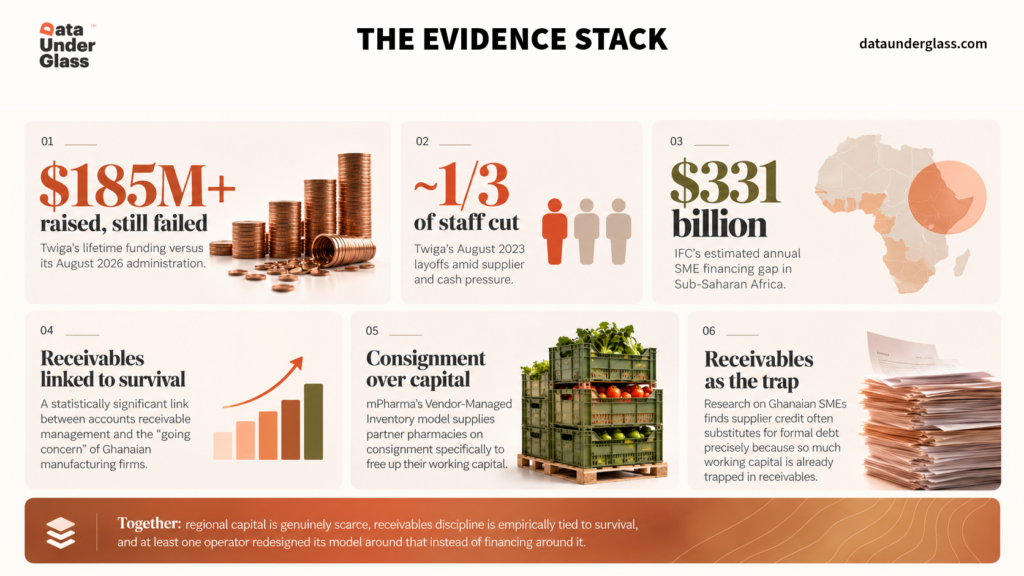
Together: regional capital is genuinely scarce, receivables discipline is empirically tied to survival, and at least one operator redesigned its model around that instead of financing around it.
Flagship Insight: The Phantom Burn Illusion
Trapped working capital can look like a funding gap. The business has recorded the revenue, bought the stock, and delivered the goods. But until customers pay and inventory converts into sales, much of that value remains unavailable to cover payroll, suppliers, logistics, and the next purchase cycle.
A business can look profitable on paper while running out of money in practice.
1. The Receivables Mirage: Revenue books the moment an invoice goes out, but the cash doesn’t exist until it’s collected. Twiga’s uncollected retailer credit meant growth on paper wasn’t growth in the bank. The critical questions are not simply how much the company has sold, but how quickly customers pay, how much debt becomes overdue, and how much cash remains trapped in disputed or uncollectible invoices.
2. Inventory as Frozen Cash: Spoiled or excess stock is capital already spent, not capital still available, every unsold crate of perishables is cash that can’t be recovered at all. This is why inventory management is not merely an operations concern. It directly affects liquidity. A warehouse full of stock can look like an asset while quietly restricting the cash available to keep the business running.
3. The External Reflex: When cash tightens, the default move is calling investors before auditing the ledger. Consider mPharma’s Vendor-Managed Inventory model, which supplies partner pharmacies on consignment to reduce the working capital those pharmacies need to hold inventory. The lesson is not that this model would have saved Twiga. It is that businesses can sometimes reduce their need for cash by redesigning how inventory is financed and managed, rather than repeatedly raising money to support the existing structure.
4. Scarcity Makes the Mistake Costlier: In a region with a $331 billion SME financing gap, every dollar raised to cover self-inflicted collection failure is one a business that truly needs it won’t get.
A business should know how much cash is funding growth, how much is trapped in its operating cycle, and how much is covering losses that the model has yet to solve. That is the difference between raising money to scale a viable business and raising money to postpone a reckoning.
What’s Actually Working
1. Audit receivables and inventory before every raise. Quantify what’s trapped, not just what’s burned, before a term sheet, not a crisis. A growing receivables balance or warehouse full of stock can hide a liquidity problem long before the bank balance makes it obvious.
2. Redesign the commercial model, not just the balance sheet. mPharma’s consignment approach reduced how much working capital the model needed at all. The bigger lesson is that sometimes the solution isn’t raising more money to fund the same operating cycle, but changing the cycle so the business needs less cash to function.
3. Tie incentives to cash collected, not cash invoiced. Wherever you extend retailer or customer credit, revenue on paper isn’t revenue in the account. If sales teams are rewarded for invoices rather than collections, they can hit their targets while leaving finance to manage the cash shortfall.
Steal This: The Working Capital Audit
1. Age your receivables this week: How much is over 60 or 90 days, and from whom? Identify whether overdue balances are concentrated among a few customers, tied up in disputes, or becoming unlikely to be collected.
2. Calculate your real spoilage or idle-stock cost: What’s sitting versus what’s actually needed? Include the cost of storage, handling, expiry, and cash tied up in slow-moving inventory, not just the purchase price.
3. Map which “growth” costs really fund collection delays: Separate expansion spend from cash plugging a leak. If new funding keeps covering the gap between paying suppliers and collecting from customers, your growth may be consuming more cash than your forecasts reveal.
4. Ask one question before any raise: If everything owed to us were collected today, would we still need it? If the answer is yes, identify exactly what the money would fund. If the answer is no, investigate whether better collections and tighter working capital could solve part of the problem before you dilute your ownership.
Field Intelligence
Signal
- Partner concentration tracked monthly, not disclosed once a year.
- Exclusivity kept out of terms even when one partner dominates volume.
- An investor who’s also a customer treated as two risks, not one safe relationship.
- FX exposure quoted by liability, not just balance-sheet total.
Noise
- “They’re invested in us, so they’re not going anywhere.”
- “Our biggest customer is also our biggest champion.”
- “We’ll diversify once we’re bigger.”
- “That’s a platform risk, not a business risk.
Bottom Line
Summary: A single dominant partner can look like stability for years and still be the one failure point that ends the business in weeks.
Reality: Operators who track concentration as a live risk adapt when a partner exits. Those who built around one partner’s rules discover they built someone else’s business.
Hard Truth: If one partner leaving would end your company, you don’t have a business model, you have a dependency, and Moove just showed what that costs.