

Moove, the Lagos-born vehicle-financing fintech, has built a global business: $420M in annual recurring revenue, 42,000 vehicles across 29 cities (BusinessDay). Uber was both its largest Nigerian demand source and, since 2024, a lead investor. In Nigeria, Uber accounted for an estimated 60–70% of the vehicle utilization underpinning Moove’s Drive-to-Own model (BusinessDay, via co-founder Ladi Delano). On September 2, 2026, when Uber shut down Nigeria and Uganda the same day it cut 3,300 jobs, about 10% of its global workforce, ending 12 years in Nigeria. When Uber exited Nigeria on September 2, 2026, after 12 years, Moove followed five weeks later, winding down the market where it was founded. What failed wasn’t the product, it was treating a dominant partner as a foundation, not a dependency.
— Anderson Oz’
From the Operator’s Desk
What Leadership Believes: Financing drivers on the dominant ride-hailing platform was a durable model, and having that platform as an investor made it safer.
What Broke:
- Moove’s model required drivers to work Uber’s Uber Go category specifically, not ride-hailing broadly.
- Uber accounted for an estimated 60–70% of Moove’s Nigerian vehicle utilisation, per co-founder Ladi Delano.
- The fleet ran on dollar-denominated debt while drivers earned in naira, compounding the exposure.
- Uber gave no notice; within hours Moove was telling drivers to switch to Bolt and inDrive, platforms its terms were never built around.
The Reality: Uber remained an investor in Moove’s global holding company even as it exited Nigeria, proof that “investor” and “safe demand partner” aren’t the same relationship.
The Lesson: Delano called the exit “a direct consequence of Uber’s departure”, financing vehicles alone never guaranteed a sustainable business.
The Evidence Stack
Sept 2, 2026: Date Uber ended 12 years in Nigeria and 10 in Uganda, the same day it cut 3,300 jobs globally (Washington Post).
60–70%: Share of Moove’s Nigerian vehicle utilisation that Uber alone accounted for (Kudi Compass).
5 weeks: Time between Uber’s exit and Moove ending its own Nigerian operations (Legit.ng).
₦35 billion: Value of vehicles Moove is transferring debt-free to eligible drivers as it exits (Legit.ng).
9,000+ drivers, ₦57 billion: Nigerian drivers who used Moove’s financing, and the income generated before the exit (Innovation Village).
Dollar debt, naira income: The currency mismatch compounding Moove’s exposure once its demand partner left (TechLabari).
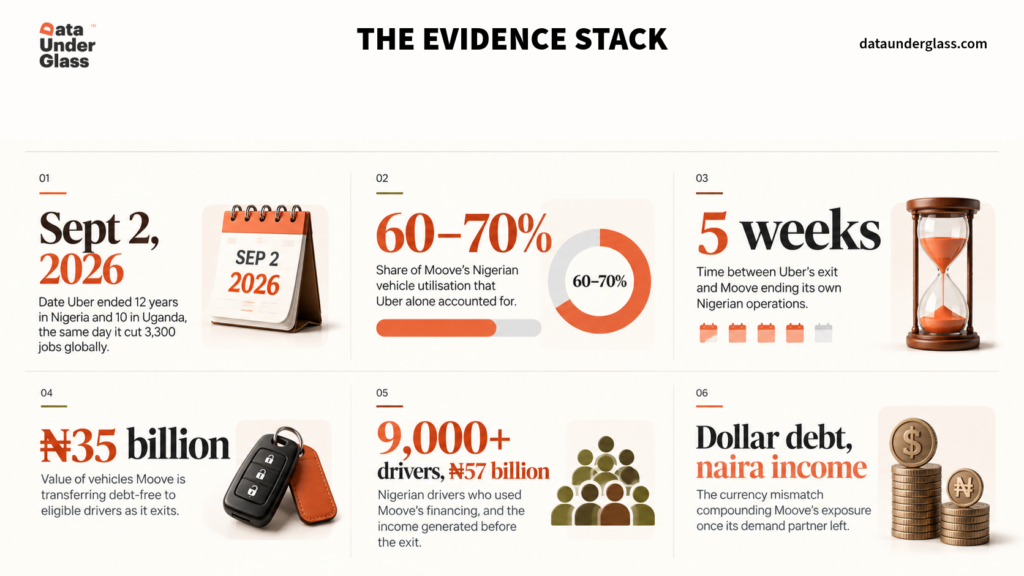
Together: a single partner supplied most of the demand, and when it left, no fleet scale or driver count could substitute for it.
Flagship Insight: The Anchor Tenant Trap
In commercial real estate, an anchor tenant’s foot traffic sustains the smaller stores around it. When it leaves, the entire ecosystem is exposed. Moove’s Nigerian business followed the same logic, with Uber supplying the demand instead of a department store.
1. Borrowed Demand Looks Like Your Own: Moove’s driver, vehicle and repayment numbers were real, but depended heavily on Uber routing trips to its drivers. The business had activity, but limited control over the demand sustaining it.
2. Investment Isn’t Alignment: Uber’s $100M stake signalled capital and validation, not a commitment to keep operating in Nigeria. When your investor is also your biggest customer or platform, their interests can diverge from your survival.
3. Concentration Becomes Design Risk: Moove’s terms required drivers to work Uber’s vehicle category, embedding platform dependency into the business model. Add dollar debt against naira income, and a single platform decision can compound two risks at once.
4. Diversification Must Precede the Exit: Moove redirected drivers to Bolt and inDrive within hours of Uber’s withdrawal, but a model built around one platform cannot be reconfigured overnight. Moove’s own exit five weeks later showed how quickly the loss of an anchor can expose the fragility beneath the numbers.
What’s Actually Working
1. Measure and cap partner concentration: Track each partner’s exact share of revenue and demand monthly. Treat 20–25%+ concentration as a standing risk, and diversify before any single partner exceeds 40–50% of volume.
2. Separate investment from demand dependency: Assess a partner’s role as investor independently from its role as a customer or demand source. Investment alignment is not channel insurance.
3. Keep contracts flexible and demand diversified: Avoid exclusive financing and supply terms that tie operations to one platform. Build alternative channels before an exit forces you to, and match liability currencies to revenue currencies to prevent platform and FX risks from compounding.
Steal This: The Anchor Dependency Audit
1. Measure your concentration this week: What share of revenue or demand depends on your largest partner? If they’re also your investor, flag the dual dependency.
2. Audit what depends on them staying: Check exclusivity clauses, partner-specific pricing, and features built around their platform. What can they walk away from, and what survives if they do?
3. Quantify your currency exposure: What currency is your debt in, and what currency generates your revenue?
4. Commit to one 90-day diversification step: Identify a new demand channel to pilot this quarter. Choose an action you’d execute if your anchor partner left tomorrow
Field Intelligence
Signal
- Partner concentration tracked monthly, not disclosed once a year.
- Exclusivity kept out of terms even when one partner dominates volume.
- An investor who’s also a customer treated as two risks, not one safe relationship.
- FX exposure quoted by liability, not just balance-sheet total.
Noise
- “They’re invested in us, so they’re not going anywhere.”
- “Our biggest customer is also our biggest champion.”
- “We’ll diversify once we’re bigger.”
- “That’s a platform risk, not a business risk.
Bottom Line
Summary: A single dominant partner can look like stability for years and still be the one failure point that ends the business in weeks.
Reality: Operators who track concentration as a live risk adapt when a partner exits. Those who built around one partner’s rules discover they built someone else’s business.
Hard Truth: If one partner leaving would end your company, you don’t have a business model, you have a dependency, and Moove just showed what that costs.