

Read Time
A Toronto cross-border payments firm spent $1.4M building compliance infrastructure, FINTRAC registration, MSB licenses in seven provinces, CBN engagement, before its product launched. In Q2 2024, the CBN changed remittance rules and gave operators 90 days to prove full compliance. Six of the seven largest competitors exited Nigeria. The Toronto firm’s volume tripled. Ponemon Institute and Globalscape found non-compliance costs 2.71× more than maintaining a proactive programme. Non-compliance doesn’t just create legal risk, 46% of early-stage fintechs have no internal audit function at all (Deloitte, 2024), it creates a market-exit countdown your competitors are quietly running while you celebrate speed.
From The Operator’s Desk
Case in Point: Q3 2024. Toronto cross-border payments firm. Canada–Nigeria corridor. FINTRAC-registered, seven-province MSB-licensed, CBN-engaged before launch. Cost: $1.4M. Timeline: three years.
What Broke (for everyone else):
- Grey Zone Assumption: Competitors operated without licences, treating compliance as optional overhead and speed as competitive edge.
- The 90-Day Wall: When the CBN mandated full compliance, three years of trust could not be replicated on deadline. Licences, banking relationships, and regulator familiarity are not built in a quarter.
- Market Exit: Six of seven largest competitors left Nigeria, not from product failure, but from paperwork they chose not to file.
The Reality:
Volume tripled in three months with zero product changes. A major Canadian bank offered an exclusive corridor partnership. Competitors’ combined market share became available overnight, through regulation, not competition.
The Lesson:
Compliance is not insurance. It is infrastructure. The $1.4M spent before it was needed is the only thing between a valuation and a 90-day eviction notice from the market.
The Evidence Stack
- 2.71×Cost of non-compliance vs. a proactive compliance programme(Ponemon Institute / Globalscape)
- 46%Early-stage fintechs to Series B with no internal audit function, the most exposed to a regulatory event(Deloitte, 2024)
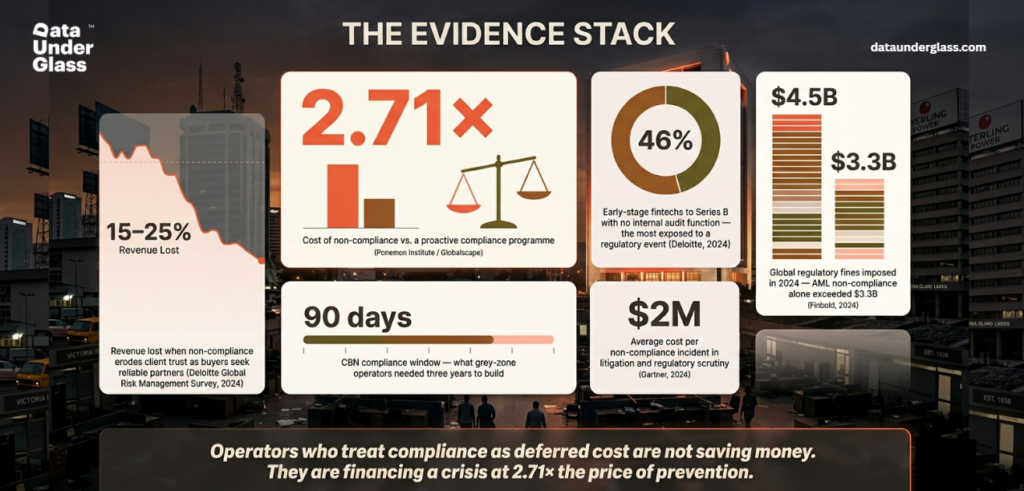
- 15–25%Revenue lost when non-compliance erodes client trust as buyers seek reliable partners(Deloitte Global Risk Management Survey, 2024)
- $4.5BGlobal regulatory fines imposed in 2024, AML non-compliance alone exceeded $3.3B(Finbold, 2024)
- $2MAverage cost per non-compliance incident in litigation and regulatory scrutiny(Gartner, 2024)
- 90 daysCBN compliance window, what grey-zone operators needed three years to build
Operators who treat compliance as deferred cost are not saving money. They are financing a crisis at 2.71× the price of prevention.
Flagship Insight: The Four Layers of the Compliance Moat
Build all four before you need them. In the Canada–Africa corridor, each layer compounds the next.
1. Licensing as Market Access: A license is a market credential. Canadian MSB licenses and FINTRAC registration function as trust signals in African markets lacking equivalent local frameworks. The licensed operator gets the enterprise deal and the banking partnership. The unlicensed one gets the exit notice.
2. Regulator Engagement Before Launch: The Toronto firm met the CBN before its product was finished. When the rule changed, they were in the room. Competitors read the press release. Early engagement converts compliance from reactive scramble into strategic relationship, and delivers intelligence competitors will never have.
3. Compliance as Sales Credential: Enterprise buyers in financial services run compliance audits before evaluating your product. Without the licence, you don’t lose the demo, you never get invited. The Toronto firm’s banking partnership came from a credential the bank could verify, not a pitch deck.
4. The Retrofit Tax: Building compliance retroactively costs 2.71× more — and in a regulatory event, there is no time. The CBN’s 90-day mandate was not a hardship for the compliant operator. It was a weapon deployed in their favour.
What’s Actually Working
1. Regulatory Architecture by Design: Map licensing obligations before writing any code involving money or data. In the corridor: FINTRAC, provincial MSB licenses, and direct central bank engagement, before launch, not after the first enforcement signal.
2. Compliance into GTM: Corridor operators who led with license credentials in sales decks removed the enterprise security audit gate entirely, shortening deal cycles without changing the product once.
3. The 90-Day Scenario Test: If your target market’s regulator mandated full compliance tomorrow, what happens to your business? If the answer is exit, your current cost savings are pre-financing a crisis at 2.71× prevention cost.
Steal This: The Compliance Moat Audit
1. The Licence Gap Test: List every jurisdiction where you collect payments, hold data, or process transactions. Any gap is a potential 90-day notice sitting on a regulator’s desk.
2. The Retrofit Estimate: What would it cost to build your compliance infrastructure from scratch in 90 days, legal fees, regulator relationships, banking partnerships included? That is your actual exposure. Compare it to proactive build cost today.
3. The Sales Audit: In your last five enterprise deals above $50K, when did compliance come up? After the demo means lost time. Never means you may have been disqualified before the meeting started.
4. The Regulator Check: When did you last speak directly with the regulator in each operating market? Never means you are not a corridor operator, you are a grey-zone tenant whose landlord hasn’t knocked yet.
Field Intelligence
Signal
- Compliance architecture built before product launch, not after funding
- MSB and FINTRAC licenses used as enterprise sales credentials in corridor deals
- Direct central bank engagement before market entry in Nigeria, Kenya, and Ghana
- Compliance budget treated as GTM capital, not Legal overhead
Noise
- Calling unlicensed cross-border operations “regulatory arbitrage”
- Treating compliance as Legal-only with no revenue mandate
- Assuming early-stage exemptions outlast company growth
- Building compliance only when investors or acquirers demand it
The Bottom Line
Stop treating compliance as insurance you hope never to use. In the Canada–Africa corridor, regulatory infrastructure is the only competitive moat your competitors are too impatient to build — and when a rule changes, the market hands you their clients overnight.
The provocative reality: While grey-zone competitors called the $1.4M spend reckless, the Toronto firm watched six rivals exit Nigeria in one quarter and tripled volume without touching its product.
The hard truth: The grey zone is not a business strategy — it is a lease with a regulator who hasn’t set your eviction date yet.