

A Toronto-based enterprise HR platform with $12M ARR managing 340 accounts across the Toronto–Lagos corridor boasted a 94% gross retention rate, a 4.2/5 CSAT, and a +38 NPS. Yet 31% of renewing customers showed declining usage and zero expansion, renewing out of procurement inertia before quietly churning 12 months later. The distinction most CS leaders miss is the one between a usage and retention manager and a churn manager: one is proactive; the other is reactive. Both have their place, but most organizations are running a churn management function while calling it retention—and the numbers look healthy right up until the contract cycle exposes what the telemetry was showing all along. 66% of customer success managers spend a significant portion of their working day on repetitive administrative processes, and 63% wish they had more time for actual client engagement. Bain’s 2025 analysis confirms that when CS managers are buried in administrative tasks, the real cost isn’t the hours lost—it’s the growth opportunity destroyed.
— Anderson Oz’
From The Operator’s Desk
Case in Point: Q3 2025 through Q2 2026. Toronto-based enterprise HR platform. $12M ARR. 340 accounts. Toronto–Lagos corridor operations. Headline metrics: 94% gross retention, 4.2/5 CSAT, +38 NPS. Actual condition: 31% of renewing accounts in usage decay with zero expansion activity.
What Broke:
- The Administrative Drain: CS spent 64% of operational time on renewal logistics—contract routing, billing coordination, renewal reminders, with only 12% of bandwidth allocated to outcome realization.
- The Usage Blindspot: Active usage decay went unmonitored across renewing cohorts. The renewal dashboard was green. The product engagement dashboard was not being reviewed.
- The Billing Clerk Problem: Account managers acted as contract administrators rather than growth advisors, tracking renewal dates instead of tracking whether customers were extracting ROI from the product.
- The NPS Illusion: A +38 NPS from individual user responses did not reflect committee-level renewal decisions, which are dictated by enterprise switching friction and procurement inertia rather than user satisfaction scores.
The Reality:
Customers stayed not because they extracted ROI, but because high switching costs and contract inertia delayed their departure. The renewal was secured by paperwork, not by outcome. The churn was not prevented; it was postponed by 12 months at full contract cost.
The Lesson:
A churn manager reacts when a customer signals they are leaving. A usage and retention manager prevents the signal from ever forming. If your CS team only activates when a renewal is at risk, you are running reactive churn management and calling it a retention strategy. A renewal secured by switching friction instead of outcome realization is delayed churn with a 12-month billing cycle attached.
The Evidence Stack
- 66% Of CSMs spend a significant portion of their working day on repetitive administrative processes rather than strategic client engagement (Vitally CS Research, 2024)
- 63% Of CSMs wish they had more time dedicated to client engagement, administrative load is the primary constraint on CS value delivery (Vitally CS Research, 2024)
- 68% Of B2B executives feel customers are less loyal than they used to be, the direct consequence of teams measuring satisfaction rather than outcome realization (Bain & Company via CustomerGauge)
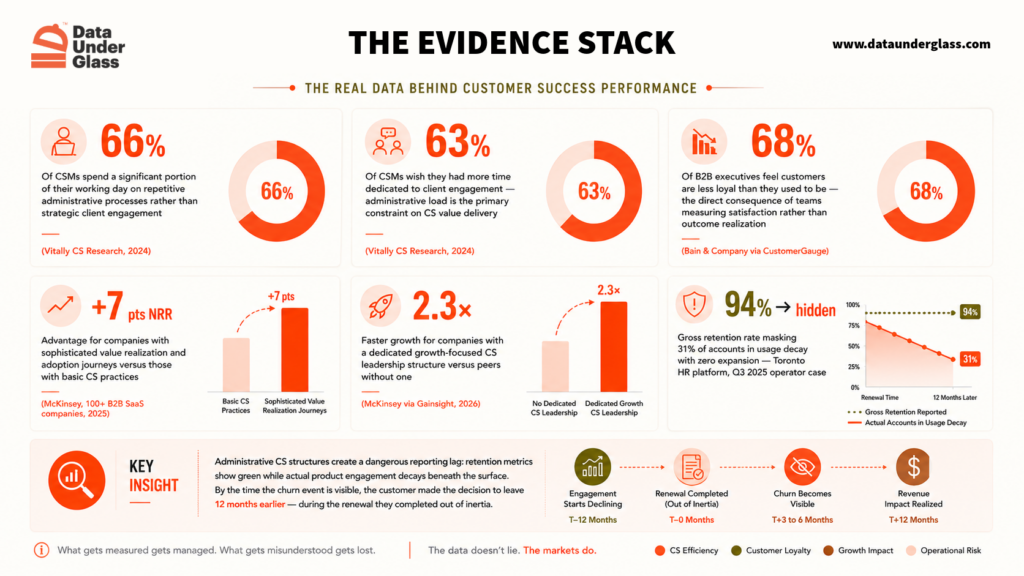
- +7 pts NRR Advantage for companies with sophisticated value realization and adoption journeys versus those with basic CS practices (McKinsey, 100+ B2B SaaS companies, 2025)
- 2.3× Faster growth for companies with a dedicated growth-focused CS leadership structure versus peers without one (McKinsey via Gainsight, 2026)
- 94% → hiddenGross retention rate masking 31% of accounts in usage decay with zero expansion, Toronto HR platform, Q3 2025 operator case
Administrative CS structures create a dangerous reporting lag: retention metrics show green while actual product engagement decays beneath the surface. By the time the churn event is visible, the customer made the decision to leave 12 months earlier, during the renewal they completed out of inertia.
Flagship Insight: The Inertia Mask
The hidden mechanism is The Inertia Mask: evaluating customer health through lagging renewal metrics conceals product irrelevance until revenue collapses. The difference between a usage and retention function and a churn management function is where the intervention happens, before the signal or after it. Three compounding layers drive the damage when you choose reactive over proactive.
1. The Administrative Drain
CS teams spend the majority of their time on renewal paperwork because leadership measures ticket throughput and renewal close rates not customer ROI. Bain’s 2025 analysis is direct: the real cost of administrative overload isn’t the hours spent on manual tasks, it’s the relationship-building and growth creation that doesn’t happen. Across the Toronto–Lagos corridor, administrative bloat starves high-value accounts of the strategic guidance that would extend product engagement and trigger expansion, the outcomes a usage and retention manager would have caught months before churn risk surfaced.
2. The Committee Blindspot
Individual CSAT and NPS responses carry limited predictive power for enterprise renewal decisions, which are driven by committee dynamics, switching friction, and budget cycles. McKinsey confirms that CX ratings are consistently higher in B2C than B2B, and that B2B businesses must work significantly harder to maintain loyalty. A +38 NPS tells you individual users are not actively unhappy. It does not tell you the CFO is quietly questioning the budget line. A churn manager finds out when the renewal is declined. A retention manager finds out when usage starts declining, which is always earlier.
3. The Expansion Deficit
Chasing administrative renewals prevents CS teams from identifying workflow integration gaps, underutilised features, and expansion triggers within existing accounts. McKinsey’s analysis of 100+ B2B SaaS companies found that the NRR gap between sophisticated value-realization journeys and basic CS practices is 7 percentage points, compounding annually on every account in the base. Every administrative renewal that bypasses a value conversation is an expansion opportunity the competitor will eventually capture.
What’s Actually Working
1. Restructure Into Functional Pods
Split your CS team into Outcome Managers, 80% of their time on value realization against verified customer KPIs—and Renewal Administrators whose role is 100% contract logistics. These are not the same job. Treating them as the same job is why your best CS talent is chasing renewal signatures instead of building the proactive usage intelligence that prevents churn from forming in the first place. The separation requires distinct reporting lines, distinct compensation structures, and distinct success metrics.
2. Tie Compensation to Customer KPI Achievement
Outcome Managers should be evaluated on verified customer KPI achievement, measurable improvements in the client’s own operational metrics, documented and attributed to the product. Never on raw renewal percentages. A renewal closed by switching friction pays the same commission as a renewal earned by outcome, which means your current structure incentivises the reactive model at every account in your base. Change the metric and you change the behaviour.
3. Integrate Relationship-Depth Metrics
In the Toronto–Lagos corridor, automated telemetry captures product usage but misses the relationship signals that predict enterprise renewal decisions, executive alignment, champion stability, informal stakeholder sentiment, and budget holder access. Supplement usage data with structured stakeholder health signals and quarterly executive alignment reviews. A product health score without a relationship health score is half a picture in a market where trust mediates the renewal decision before procurement ever opens the contract.
Steal This: The CS Forensics Audit
1. Audit CS Time Allocations: Track 14 days of CS activity across your team. Quantify hours on logistics versus active workflow optimization and outcome conversations. Above 50% in favour of administration means your CS function is running churn management, not usage and retention management.
2. Isolate Usage Decay: Cross-reference last quarter’s renewals with product usage telemetry. Any account that renewed without a concurrent increase in active usage is a hidden churn risk, one procurement cycle from non-renewal regardless of what the retention dashboard shows.
3. Map Committee Breadth: For your top 20 accounts, map active relationships beyond the primary procurement champion. If a single contact departure leaves your team with no active relationship inside the account, you have a single point of failure with a renewal date attached, not a retention architecture.
4. Calculate Outcome-to-Admin Ratio: For each CS team member, calculate time spent on verified customer outcome delivery versus administrative renewal logistics. Below 40% outcome-focused means that person is delivering clerical value, invisible on the payroll, visible on the NRR.
Field Intelligence
Signal
- Restructuring CS around customer KPI achievement, separate from contract renewals
- Tracking hidden churn through active usage decay, not lagging NPS scores
- Deploying relationship-depth metrics across international B2B corridors alongside telemetry
- Tying NRR gains directly to outcome-focused staffing with separated compensation
Noise
- Celebrating high NPS and CSAT as definitive proof of customer health
- Using gross retention as the primary metric for CS team performance
- Forcing high-value CS talent to manage administrative billing and contract logistics
- Assuming procurement-driven renewals indicate organic product adoption and expansion potential
The Bottom Line
Most organizations employ a churn manager when what they need is a usage and retention manager. The churn manager activates when a customer signals departure. The retention manager ensures that signal never forms. If your CS team only engages deeply when a renewal is at risk, you are not running a retention strategy, you are running a clerical desk that produces lagging metrics while the real story plays out in your usage telemetry, unread.
The provocative reality: Operators who reorganize CS around proactive outcome delivery capture the NRR advantage McKinsey places at 7 percentage points above peers, compounding on every account in the base, every quarter. Those who rely on administrative CS models inherit a silent defection engine that only becomes visible when the contract cycle finally reveals what the usage data was showing all along.
The hard truth: If your CS team spends their day chasing signatures instead of proving ROI, you don’t have a retention strategy, you have a slow-motion defection engine with excellent paperwork.