

A Vancouver B2B logistics platform at $13.4M ARR lost $4.8M to churned revenue in 18 months because its 12-person sales team earned a flat 8% upfront commission with zero clawbacks. The pipeline looked healthy. The reps hunted bad-fit accounts that could not be retained, just to collect immediate payouts. Acquiring a new customer costs 5 to 25 times more than retaining one. Yet 75% of software companies saw declining retention in 2024 despite increased spending. The commission plan and the business had opposite incentives.
— Anderson Oz’
From The Operator’s Desk
Case in Point: In Q3 2024, a Vancouver logistics firm projected that a $6.2M gross-add sales program would rocket the company past its Series B targets. The leadership reported a highly motivated sales floor and an expanding pipeline to its board of directors.
What Broke:
- The Transactional Loop: A bad-fit account paid the same commission as a great one. Reps optimized for signing velocity, not account health.
- The Headcount Band-Aid: Leadership added Customer Success to manage un-retainable clients — overhead without fixing the source.
- The Churn Leak: $6.2M in new contracts closed. $4.8M lost to churn simultaneously. Net gain: $1.4M ARR. Full commissions paid on phantom growth.
- The Warning Ignored: Customer Success flagged bad-fit profiles 8 months prior. The commission structure stayed intact.
The Reality:
Upfront-only commission creates intentional misalignment where pipeline velocity directly starves net revenue expansion.
The Lesson:
Declining NRR is not a customer satisfaction problem. It is a sales compensation design failure. Pay for the handshake and your reps will sell to anyone with a pulse.
The Evidence Stack
- 5–25×: Cost of acquiring a new customer versus retaining one (HBR via Lighter Capital)
- 75%: Software companies with declining retention in 2024 despite increased spend (Paddle via Genesys Growth)
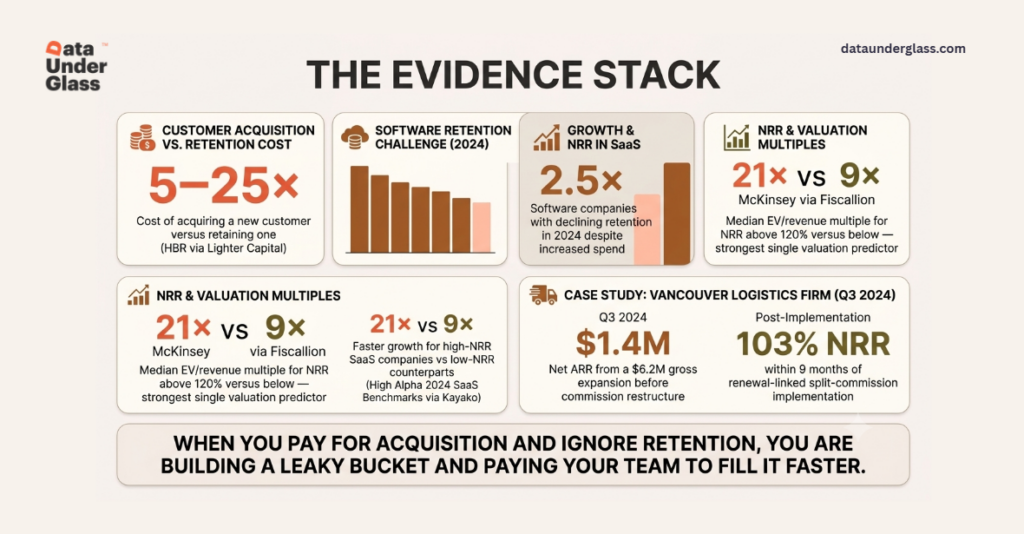
- 2.5×: Faster growth for high-NRR SaaS companies vs low-NRR counterparts (High Alpha 2024 SaaS Benchmarks via Kayako)
- 21× vs 9×: Median EV/revenue multiple for NRR above 120% versus below, strongest single valuation predictor (McKinsey via Fiscallion)
- $1.4M: Net ARR from a $6.2M gross expansion before commission restructure, Vancouver logistics firm, Q3 2024
- 103%: NRR within 9 months of renewal-linked split-commission implementation, same firm
When you pay for acquisition and ignore retention you are building a leaky bucket and paying your team to fill it faster.
Flagship Insight: The Commission Churn Loop
Upfront-only incentives institutionalise a multi-layered breakdown. Three layers compound the damage.
1. The Toxic Pipeline Layer
Reps identify profiles easy to convert but impossible to retain, and target them for short-term earnings. Customer Success inherits the damage. The reps collect the commission. No one owns the gap.
2. The Executive Vesting Fracture
Short equity vesting cliffs push leadership to optimise for 12-to-18-month horizons, pumping vanity growth metrics and leaving a hollowed-out retention model for the next funding cycle.
3. The Corridor-Exchange Choke
In the Toronto–Lagos and Vancouver–Nairobi corridors, operators pay commissions in USD/CAD while billing African clients in NGN/KES. A currency devaluation after close turns a signed contract into a net-negative drain. The commission was paid. The revenue disappeared.
What’s Actually Working
1. Split-Commission Mechanics
4% at close, 4% at successful month-12 renewal. Reps stop hunting accounts they cannot keep because those accounts will not pay out the second half. Industry guidance on renewal-linked commission structures →
2. Collective NRR Bonuses
Tie a portion of compensation to team NRR. When retention falls, everyone’s bonus falls, which changes what enters the CRM before a bad-fit account is ever created.
3. Corridor Payout Alignment
Anchor commission payouts to the currency collected in the underlying contract. A rep billing a Lagos client in Naira is paid in Naira. Personal stake in FX resilience replaces personal stake in ACV at signing.
Steal This: The Incentive Architecture Audit
1. The 49-Point Gap Test: For every contract closed in the last 12 months, match the rep, the commission paid, and the renewal status. The delta between gross commission and net ARR retained is your true commission loss.
2. The CS Load Test: If Customer Success spend exceeds 30% of new contract value on firefighting, freeze the commission structure before hiring more CS.
3. The Currency Audit: If reps earn hard currency commissions on contracts billed in NGN or KES, recalculate every payout against actual settlement rate. The gap is your untracked margin leak.
4. The Clawback Integration: Introduce a mandatory 12-month churn clawback on all new enterprise accounts this week. Paying full commissions on revenue that will not exist in 90 days is worse than the conversation.
Field Intelligence
Signal
- Splitting commissions between close and renewal
- Linking bonuses to collective team NRR targets
- Adjusting compensation for local African costs and currency collection
- Matching payout currency to contract collection currency
Noise
- Hiring more Customer Success reps to fight rising churn
- Assuming Western salary structures work in Lagos or Nairobi
- Measuring performance solely on gross new ACV closed
- Paying hard currency commissions on unhedged local contracts
The Bottom Line
Your sales team is not broken. Your compensation plan is. When you reward reps for the close and leave Customer Success to absorb the aftermath, you are underwriting your own decline.
The provocative reality: Operators who anchor incentives to contract longevity are unlocking sustainable self-funding expansion across the corridor. Those who did not are watching their runway dissolve in an endless cycle of toxic customer acquisition, funded by a commission structure designed to reward exactly that.