

An $18M ARR Vancouver-based B2B SaaS firm expanded its engineering and support operations into Nairobi, ballooning from 24 to 67 employees in 18 months. Management expected linear market capture across the Canada–Africa corridor. Instead, ARR growth collapsed from 45% to 23%. Output per employee fell 34%. The bottom 30% of newly hired staff consumed 40% of leadership’s daily bandwidth. McKinsey’s analysis of 600,000 professionals found that in highly complex roles, engineering, software development, management, top performers are 800% more productive than average. In B2B sales specifically, top-quartile performers generate 2.5x more gross margin per dollar invested than bottom-quartile peers. Headcount is not a growth strategy. It is a wager on talent density, and most growth-stage founders are losing that wager without knowing the stakes.
From The Operator’s Desk
Case in Point: Q1 2025 through Q3 2026. Vancouver-based B2B SaaS firm. $18M ARR. Engineering and support expansion into Nairobi. Headcount: 24 to 67 employees in 18 months.
Assumption:
Adding local headcount in Nairobi would proportionally increase engineering throughput, accelerate pipeline velocity, and capture corridor market share faster.
What Broke:
- The Interview Illusion: Hiring loops averaged 47 minutes with zero practical output testing, selecting for presentation skills, not execution capability.
- The Reference Blind Spot: Background vetting relied exclusively on candidate-supplied references, the operational equivalent of asking applicants to grade their own exam.
- The Span-of-Control Fracture: As team size crossed 50, executive spans of control fragmented. Founders shifted from executing growth strategy to mediating internal friction.
- The Bandwidth Drain: The bottom 30% of new hires consumed 40% of leadership’s daily bandwidth, inflating operational drag while ARR growth rate halved from 45% to 23%.
The Reality:
Output per employee fell 34%. The expansion produced the appearance of organizational scale while destroying the unit economics that had driven the company to $18M ARR. More people. Less per person. More management overhead. Less strategic thinking at the top.
The Lesson:
Headcount is an operational liability until proven otherwise. Empty seats cost nothing. Low-density hires destroy unit economics, drain elite performers, and transfer leadership capacity from growth to internal crisis management.
The Evidence Stack
- 800%: More productive, top performers versus average in highly complex roles: engineering, software development, and management (McKinsey, analysis of 600,000 professionals)
- 2.5×: Higher gross margin per dollar invested by top-quartile B2B sales performers versus bottom-quartile peers (McKinsey, analysis of ~500 B2B companies)
- 40%: Of management time consumed by underperforming employees, the bandwidth drain that halted strategic growth in the Vancouver operator case (Gallup Workplace Research)
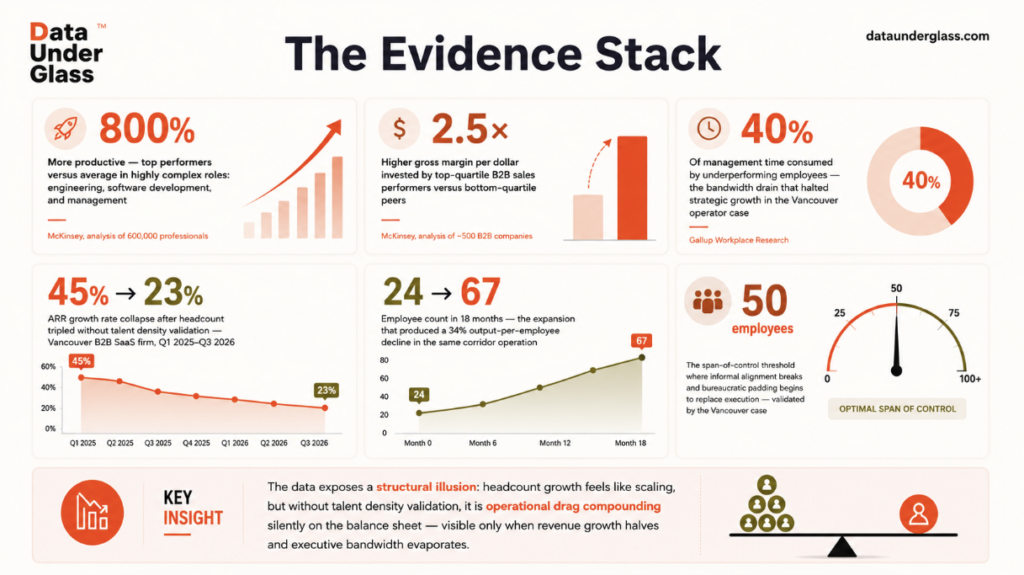
- 45% → 23%: ARR growth rate collapse after headcount tripled without talent density validation, Vancouver B2B SaaS firm, Q1 2025–Q3 2026
- 24 → 67: Employee count in 18 months, the expansion that produced a 34% output-per-employee decline in the same corridor operation
- 50 employees: The span-of-control threshold where informal alignment breaks and bureaucratic padding begins to replace execution, validated by the Vancouver case
The data exposes a structural illusion: headcount growth feels like scaling, but without talent density validation, it is operational drag compounding silently on the balance sheet, visible only when revenue growth halves and executive bandwidth evaporates.
Flagship Insight: The Bandwidth Tax of Mediocrity
Conventional management treats headcount as a linear driver of capacity. In operating reality, adding low-density hires introduces organisational drag that scales exponentially. Three mechanisms drive the destruction.
1. The Management Drag Effect
When hiring standards loosen to hit headcount milestones, leadership time pivots from strategic growth to operational babysitting. Gallup’s workplace research consistently shows that managers who inherit underperforming teams spend the majority of their discretionary time on performance correction rather than strategy—an invisible tax that the P&L does not record but the ARR growth rate reflects precisely. Managing underperformance hijacks C-suite bandwidth. The Vancouver firm’s founder spent 40% of daily executive hours on the bottom 30% of its headcount. That is not a people problem. It is a hiring architecture problem.
2. The Cross-Border Credential Trap
Canadian talent assessment frameworks over-index on institutional credentials. African operating environments demand adaptive capability, local relationship capital, and comfort with infrastructure volatility. Standardizing on CVs rather than execution testing creates immediate delivery failure across the corridor. McKinsey’s talent research confirms that the performance gap between top and average employees widens significantly with role complexity—and cross-border expansion roles are among the most complex an organization can create. Hiring the wrong person for a Nairobi operations role does not underperform linearly. It underperforms exponentially, because the role sits at the intersection of two operating environments with opposing assumptions.
3. Span-of-Control Fragmentation
Crossing 50 employees breaks informal alignment. Without explicit output contracts tied to individual roles, middle management builds bureaucratic padding to conceal low talent density, creating the appearance of organizational structure while compressing actual throughput. The 50-person threshold is not arbitrary; it is the point at which the founding team can no longer maintain direct knowledge of individual contributor output, and where undocumented performance expectations become organizational debt.
What’s Actually Working
1. Enforce 3-Hour Practical Assessments
Replace conversational interviews with real-world work sample tests that mirror actual job conditions. A three-hour practical assessment costs the hiring manager three hours. A bad hire at $120K fully-loaded costs $360K in direct remediation and 40% of their manager’s attention for the duration of their tenure. The economics are not close. Corridor operators who implement practical testing before any offer report immediate improvements in 90-day output and material reductions in early attrition.
2. Execute Reverse Reference Vetting
Bypass candidate-provided references entirely. Contact former peers and direct managers independently, not the contacts the candidate selected, to verify real execution output and working style under pressure. In cross-corridor hiring, where credential verification is harder and social networks are tighter, this step is not optional. It is the primary filter between a high-density hire and an expensive management problem.
3. Institute 90-Day Performance Contracts
Tie every new hire to explicit, measurable output targets from day one, specific deliverables, defined timelines, binary success criteria. If targets are missed at Day 90, act immediately. The Vancouver firm’s core error was not the initial hires, it was retaining underperformers past the point where corrective action was still low-cost. Every week a low-density hire stays in a critical role after missing their 90-day contract is a week the high-density performers around them are evaluating their options.
Steal This: The Talent Density Audit
1. The Re-Hire Test: Ask yourself: “If every employee resigned today, whom would I actively fight to re-hire?” The employees who do not make that list are the cost of your current talent density problem. Action the rest.
2. The Leadership Calendar Audit: Track 14 consecutive days of executive time. Quantify hours spent fixing underperformance versus hours spent driving ARR. If the ratio exceeds 30:70 in the wrong direction, your headcount has already inverted your operating model.
3. The Requisition Freeze: Pause every open hiring role that relies solely on CV review and unstructured interviews. Do not resume until a practical work-sample assessment is in place for each role. An unfilled seat is operationally neutral. A bad hire is operationally destructive.
4. The Capital Reallocation: Prune the bottom 10% of underperforming roles and reallocate that payroll to retain top-quartile talent. McKinsey’s data is unambiguous: in complex roles, a single top performer delivers what eight average performers produce. The economics of talent reallocation are not about cutting, they are about concentrating the only resource that actually compounds.
Field Intelligence
Signal
- Freezing headcount to force operational efficiency and margin expansion
- Mandating practical work-sample testing across all corridor hiring
- Evaluating African market talent on execution velocity over institutional credentials
- Pruning the bottom 10% to fund retention of top-quartile performers
Noise
- Treating headcount milestones as proof of business scaling
- Relying on candidate-provided references as a primary vetting mechanism
- Assuming North American management playbooks translate across the corridor without local adaptation
- Retaining underperforming staff to preserve team morale while elite performers reconsider their options
The Bottom Line
Scaling headcount without verified talent density dilutes execution, drains executive bandwidth, and lowers revenue per employee, the metric that every growth-stage investor will eventually calculate. A 67-person team generating $18M ARR at 23% growth is a worse business than a 30-person team generating the same ARR at 40% growth. The headcount is the cost. The density is the asset.
The provocative reality: High-density teams generate superior ARR with lower overhead and faster strategic decision cycles. Bloated organizations burn capital trying to manage internal drag, while their lean competitors compound the output gap quarter after quarter.
The hard truth: A warm body in a chair is an expensive substitute for leadership discipline.