
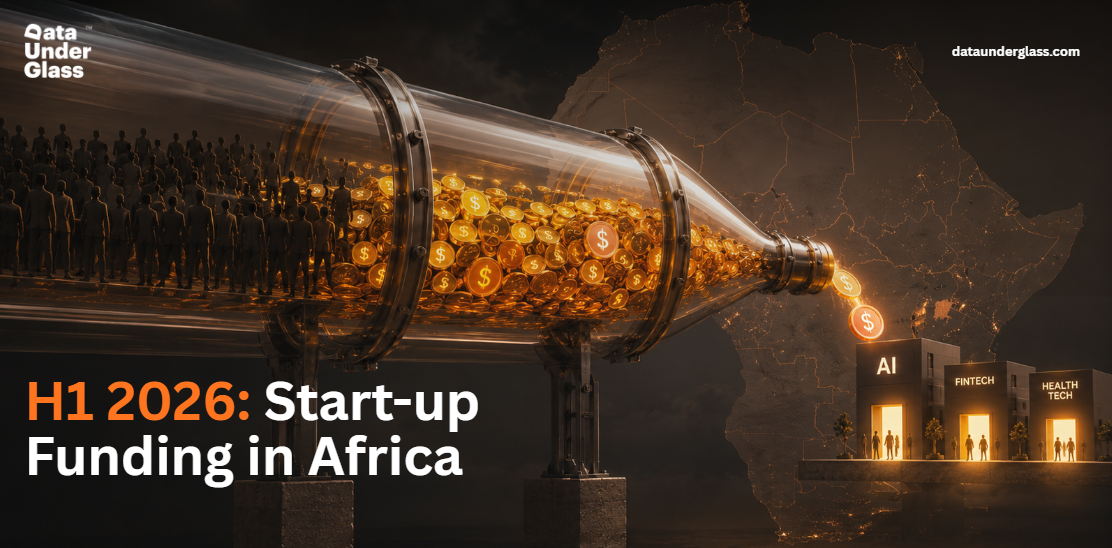
Africa’s start-ups raised $1.36 billion in H1 2026, flat against H1 2025’s $1.44 billion (-6% YoY), but down 22% from H2 2025’s $1.7 billion. On the surface, that reads as stability. Underneath, the deal count tells a different story: only 190 ventures raised $100k or more, the lowest tally since Africa: The Big Deal lowered its tracking floor to that level in 2021. The dollars held. The founders getting funded did not.
The Numbers That Matter
| Metric | H1 2026 | vs. H1 2025 | vs. H2 2025 |
|---|---|---|---|
| Total raised | $1.36b | -6% | -22% |
| Equity | $900m (66%) | -7% | ~-8% |
| Debt | $450m (33%) | +1% | ~-36% |
| Ventures raising $100k+ | 190 | Lowest since 2021 | |
| $100k–$1m bracket | 100 deals | -44% vs. H2 2025’s 179 | |
| Exits | 25 | On pace to beat 2025’s record of 48 | |
Sector-wise, fintech kept its lead at 41% of funding (~$640m), with climate tech close behind at 39%, logistics & transport at 35%, and agri & food at 7% (categories overlap, so shares don’t sum to 100%). More than 264 investors backed at least one $100k+ deal. On gender: start-ups with a female CEO captured just 2.7% of funding; those with at least one female co-founder, 6.3%, both figures essentially unchanged from prior periods, a structural gap rather than a one-period blip.
Geographically, the traditional Big Four; Egypt, Nigeria, Kenya, South Africa, still pulled in 58% of funding (Egypt 24%/$327m, Nigeria 19%/$254m, Kenya 9%/$126m, South Africa 6%/$83m), meaning 42% of $100k+ deals closed outside those four markets. The real headline, though, is Benin, which matched Egypt at 24% and $327m — a ranking Startup.Africa’s read of the same dataset called the standout surprise of the half.
Signal vs. Noise
Signal: the early-stage collapse. The $100k–$1m bracket falling 44% half-on-half, on top of a multi-period trend Max Cuvellier Giacomelli’s team has flagged repeatedly, is the number that should worry operators and ecosystem-builders most. Total dollars can be propped up by one mega-round. A shrinking base of newly-funded ventures cannot be, it’s a pipeline problem that compounds two to three years out, when today’s under-funded seed cohort should be raising Series A.
Noise: Benin’s rise, taken at face value. Benin’s entire result rides on one company—Spiro, the pan-African electric-mobility and battery-swapping firm, which raised roughly $327m across four rounds in H1, a mix of debt and equity. Spiro is incorporated with Beninese roots, but its operational headquarters sits in Kenya, where the bulk of its staff and market activity are based. Treat Benin’s #1 ranking as a data artifact of how one company is domiciled, not evidence of a new venture hub, a distinction worth making before it hardens into ecosystem conventional wisdom.
What This Means for Founders
- The $100k–$1m stage is the most contested it has been in five years. If you’re raising in this band, expect longer cycles and more competition for the same checks; blended finance, revenue-based instruments, and grant-bridged rounds are no longer a fallback, they’re a standard part of the stack.
- Geography is no longer destiny, but concentration risk still is. With 42% of deals closing outside the Big Four, capital is reachable from more markets than the “you have to be in Lagos/Nairobi/Cairo/Joburg” narrative suggests, but a single anchor deal (see Spiro) can distort a whole country’s numbers, so don’t read country-level funding stats as a proxy for depth of local investor infrastructure.
- The gender gap is a market inefficiency, not just an equity issue. At 2.7%–6.3% of funding, founding teams with women in leadership are working a structurally under-capitalized segment, which cuts both ways: less competition for the investors who do allocate there deliberately.
What This Means for Investors
- Exits are becoming a real data point, not a hope. 25 exits in H1, including Flutterwave’s acquisition of Mono (~$25m–$40m) and Araxi’s acquisition of Pay@ for $62m in South Africa, put the ecosystem on pace to beat 2025’s record of 48. That’s the strongest liquidity argument the market has had in years, worth featuring explicitly in LP conversations.
- The equity:debt mix shifted back toward equity (66:33, from 56:42 in H2 2025) even as absolute debt volume fell sharply half-on-half, a sign that large asset-backed borrowers (energy, mobility) simply had a quieter debt half after H2 2025’s surge, not that debt investors are retreating structurally.
- The barbell is real. Capital is concentrating in fewer, larger, later-stage tickets while the seed pool thins. For funds still writing $100k–$1m checks, that’s either a pricing opportunity, less competition, better terms—or a warning that your portfolio’s next-round investors are getting harder to find. Underwrite accordingly.
Pitfalls & Opportunities to Watch
Pitfall: Reading total dollars as ecosystem health. Deal count is the leading indicator here, and it’s flashing amber for a second straight period.
Opportunity: The thinning $100k–$1m bracket is structural white space for blended-finance vehicles and diaspora capital, directly relevant to Canada-based investors and family offices looking for underpriced entry points into African ventures before the next Series A cycle.
Watch: Whether Benin holds its ranking once Spiro’s next funding cycle passes, or the country’s numbers revert toward historical levels, a clean test of how much of H1’s “geographic diversification” story is durable versus one company’s balance sheet.
The dollars are steady. The bets being placed are not. That gap is where the next eighteen months of this ecosystem get decided.
Sources: Max & Maxime, “H1 2026: Amounts hold. Deal count suffers,” Africa: The Big Deal, Jul 14, 2026; Max & Maxime, “H1 2026: June saves the day!” Africa: The Big Deal, Jul 2026; “African Startup Funding Hits $1.4B in H1 2026,” Startup.Africa, Jul 2026. Underlying data: Africa: The Big Deal proprietary database (thebigdeal.gumroad.com).