
The Infrastructure Arbitrage: Building Where Others Can’t (Or Won’t)
Welcome back to Data Under Glass, the place where we strip away theory and talk about how companies actually survive.
For the last decade, venture capital pushed one doctrine everywhere: stay asset-light.
✗ No warehouses in Lagos.
✗ No trucks in Atlanta.
✗ No hardware anywhere.
That advice worked when capital was cheap and infrastructure mostly worked.
In 2025, it’s backward.
The most defensible businesses, from Nakuru to Nashville, Cape Town to Columbus, aren’t built on top of infrastructure. They are the infrastructure. They step into the gaps others avoid and turn friction into moat.
This is Infrastructure Arbitrage.
And it’s winning quietly across continents.
Today, you’re getting two operator playbooks:
• An $8.4M African last-mile siege
• An $18.5M Midwest cold-chain build
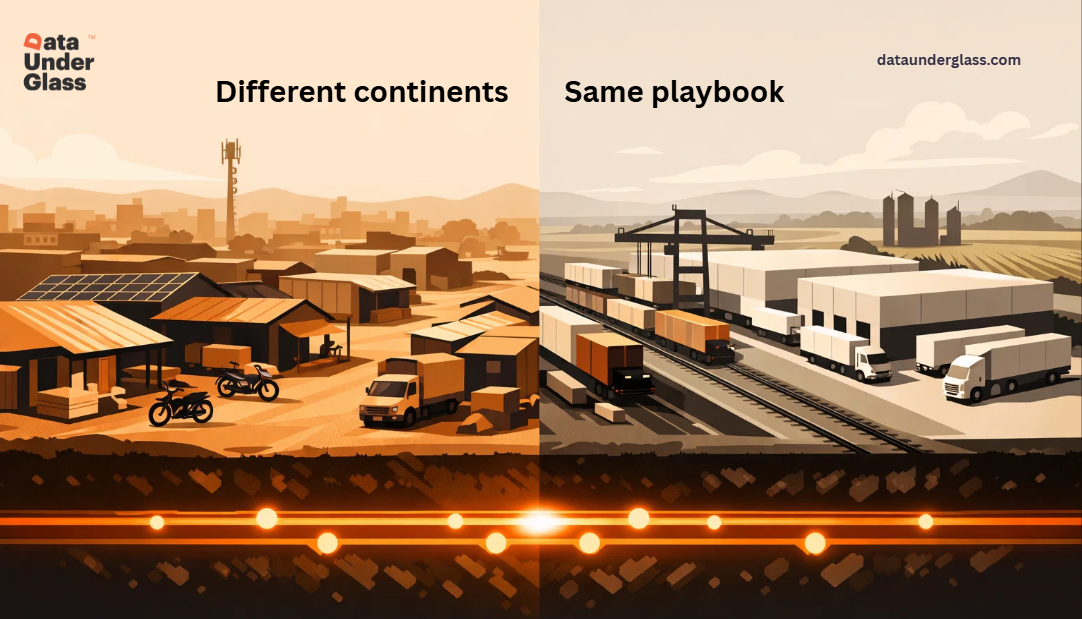
Same logic, different terrain. Identical outcome: uncopyable advantage.
— Anderson Oz’.
Case In Point: Logistics operator (Series A; East Africa + South Africa)
The Gap:
E-commerce demand exploded outside Tier 1 cities. Nakuru, Mwanza and Secondary South African metros.
Delivery was chaos, no addressing systems, unmapped roads and unreliable third-party riders.
Everyone chased Nairobi and Dar es Salaam. Nobody wanted the periphery, it was “too expensive.”
The Heavy Play:
$8.4M deployed into assets nobody wanted to touch:
This wasn’t software first. Software came after steel, fuel, and maintenance.
The Moat:
78% market share captured in 18 months.
To replicate the network today would cost over $20M at 2025 prices, plus years of learning curve. By the time incumbents reconsidered those cities, the operator already owned the customers, riders, and routing data.
Asset-light competitors couldn’t follow. They had nothing to stand on.
Case In Point: Cold-storage infrastructure fund (Series B; $45M, U.S. Midwest)
The Gap:
Regional food producers were shipping perishables 200+ miles to Chicago or Atlanta for storage, then hauling them back for local distribution. A massive logistics tax baked into every pallet.
Over 70% of U.S. cold storage is more than 20 years old. Built pre-ecommerce. Energy-inefficient. In the wrong places.
The Heavy Play:
$18.5M invested into a 200,000 sq ft automated cold hub in a Tier 2 logistics corridor (Indianapolis, Columbus, Des Moines).
The Moat:
Customer transport costs dropped 32%.
Once producers integrated directly with the facility’s Warehouse Management System, switching became painful and expensive. Capacity hit 100% in 11 months.
At stabilization, the facility valued at a 6.2% cap rate. Instant ~3x equity multiple. Not because of branding or growth hacks, but because the asset was indispensable.
Different continents but same playbook:
✓ Find where basic services don’t work.
✓ Deploy heavy capital others refuse to touch.
✓ Own the physical layer everyone eventually depends on.
The math: If the cost of third-party infrastructure plus the reliability tax
(lost customers, delays, churn) exceeds the amortized cost of building your own, you build.
In Africa, third-party riders failed 40% of deliveries outside Tier 1 cities. Ownership was cheaper in the long run.
In the Midwest, shipping pallets across states cost producers more than local storage ever would.
Infrastructure looks expensive until unreliability shows up on your P&L.
Infrastructure isn’t just costly to build. It’s brutally expensive to copy after the first mover entrenches.
Africa: inflation, network effects, and proprietary routing data push replication north of $20M.
North America: automated cold storage requires $18–22M upfront, plus customer integrations already locked into incumbents.
Code can be copied.
Physical systems can’t be cloned on a sprint.
Field intelligence shows 23% of successful infrastructure plays in 2025 involved public-private partnerships.
In Africa, renewable mini-grid and logistics projects reduce risk through government-backed offtake or land access.
In the U.S., USDA Rural Development programs provide loan guarantees and grants for cold storage and logistics in underserved corridors.
Infrastructure arrives in Tier 2 markets 3–5 years after Tier 1 hubs. Build before the state shows up and you become the default partner when it does.
Founders with lived experience across continents see these gaps earlier.
If you grew up in Kampala and now build in Chicago, or started in Johannesburg and expanded to Atlanta, you recognize fragility others assume is “edge case.” The arbitrage is even clearer.
You see infrastructure gaps others miss because you’ve lived in markets where “basic services” were never basic. That dual perspective is your competitive advantage. You know how to build in low-infrastructure environments and recognize the same patterns in neglected North American corridors.
You may also enjoy reading: The Pivot Decision: When to Persevere vs. When to Change Course
Identify Gap Markets: High economic activity, low service reliability. Africa: Tier 2/3 cities (Nakuru, Mwanza, secondary SA markets). North America: Agricultural corridors, rural broadband deserts, Midwest logistics hubs.
Run Infrastructure ROI Math: Third-party cost plus reliability tax versus build cost. If build creates 5-7 year moat and market share justifies capex, deploy heavy.
Seek Public–Private Partnership De-Risking: 23% of winners partner with governments. Land access, regulatory fast-tracking, or first-loss capital reduces capex 40-60%.
Deploy Before Government Timing: Infrastructure gaps close 3-5 years behind Tier 1 markets. Build now, entrench through network effects, become essential partner when official infrastructure arrives.
Own the Data Layer: Infrastructure generates proprietary data (routing, thermal optimization, addressing systems). This becomes the asset competitors must rent even if they build parallel infrastructure.
✓ $8.4M African Moat: Average infrastructure capex for Tier 2/3 market dominance, creating 5-7 year competitive barrier
✓ $18.5M North American Cold Hub: Sweet spot for regional automated facility, generating 3x equity multiple at 6.2% cap rate
✓ 35-55% African Last-Mile Tax: Delivery costs as percentage of product price versus 28% globally
✓ 70% Obsolete Cold Storage: U.S. facilities over 20 years old, built pre-e-commerce, energy-inefficient
✓ $20M+ Replication Cost: What competitors face replicating 2025’s infrastructure due to inflation and network effects
✓ 23% PPP Success Rate: Infrastructure plays with government partnerships, reducing capex 40-60%
✓ 3-5 Year Government Lag: Tier 2 infrastructure investment timeline behind major hubs
✓ Signal: Infrastructure-as-moat attracting patient capital (pension funds, sovereign wealth) as defensive advantage becomes clear
✓ Noise: “Asset-light” dogma preventing defensible moat construction
The greatest arbitrage in 2025 isn’t in algorithms. It’s in the friction of the real world.
From Nakuru to Nashville, the logic is the same:
✓ Build where others won’t.
✓ Own what others outsource.
✓ Turn inconvenience into barrier.
The African operator didn’t win with better dashboards or UIs. They won with motorcycles and warehouses.
The Midwest operator didn’t win with branding. They won with steel, automation, and power economics.
You can copy code.
You can’t copy infrastructure once it’s embedded.
Before you default to asset-light, ask yourself:
Infrastructure isn’t overhead.
It’s the moat.
From Kampala to Columbus, the winners are building where others won’t.
Data Under Glass is an exclusive weekly deep-dive analysis uncovering the data-driven stories behind the most successful scale-ups. We surface the patterns your pitch deck doesn’t capture and the risks your Excel model can’t see.
Forward this to the founder still chasing “asset-light” while competitors pour concrete.
Till next time, this insight is DUG Weekly!