

Most startups don’t fail because they run out of money; they fail because they mistake “friendly” noise for product-market fit and scale into a vacuum. CB Insights’ 2024 analysis of 431 failed VC-backed companies found that 43% failed due to poor product-market fit, the leading root cause, ahead of running out of capital, which is almost always the final symptom rather than the disease. The Startup Genome Report confirms that 74% of high-growth startups fail specifically due to premature scaling, scaling on signals that were never a real fit in the first place. If you are currently treating pilot conversion rates or founder-led introductions as evidence of PMF, you are not building a business—you are subsidizing a mirage that will evaporate the moment you stop paying for it.
— Anderson Oz’
From The Operator’s Desk
Case in Point: In Q2 2025, a Calgary-based B2B marketplace for African agricultural inputs entered the market with what appeared to be perfect momentum. The founder leveraged his existing professional network to onboard 3 Nigerian cooperatives for a pilot. The pitch: 94% user engagement and $340K GMV. The reality: a 0% organic referral rate and 73% churn the moment the social contract expired.
What Broke:
- The Relationship Subsidy: All 3 pilot cooperatives were connected to the founder’s personal network. They had engaged out of relationship obligation, not product utility—creating an artificial inflation of metrics where pilot data looked like a market trend but was actually a social favor.
- The Premature Scale: The founder declared PMF, raised $4.2M in seed money, hired a 14-person team, and expanded to Kenya and Ghana on the assumption of replicable scale.
- The Breaking Point: Month 8 post-funding. The original 3 cooperatives refused to renew. The entire expansion collapsed. Average order value among non-network customers was 61% below pilot levels.
- The False PMF Tax: The company burned $3.1M in 11 months before corrective action. The team was cut from 14 to 4. Multi-country expansion abandoned. Eighteen months of runway wasted in defensive recovery.
The Reality:
The underlying unit economics were entirely negative — visible in the 0% organic referral rate and 73% monthly churn among non-network customers. The team was forced to freeze all customer acquisition pipelines for 60 days to overhaul product mechanics and customer success workflows. By shifting focus from vanity acquisition to product retention, customer lifetime extended to 34 months, and net revenue retention climbed from 67% to 103%.
The Lesson:
Traction is not PMF. Traction is the result of your hustle. PMF is the result of your product’s inherent utility. Growing on false signals doesn’t just waste money — it actively destroys your ability to find the real signal once the social contract expires.
The Evidence Stack
- 43%: Of VC-backed startup failures trace to poor product-market fit—the #1 root cause, ahead of running out of capital (CB Insights, 2024—431 companies)
- 74%: High-growth startups fail due to premature scaling—scaling before genuine fit is confirmed (Startup Genome Report via Unicorn Screener)
- 40%+: “Very disappointed” NPS threshold—validated PMF signal separating real fit from surface engagement (First Round Capital / Superhuman analysis via Dev Corporate
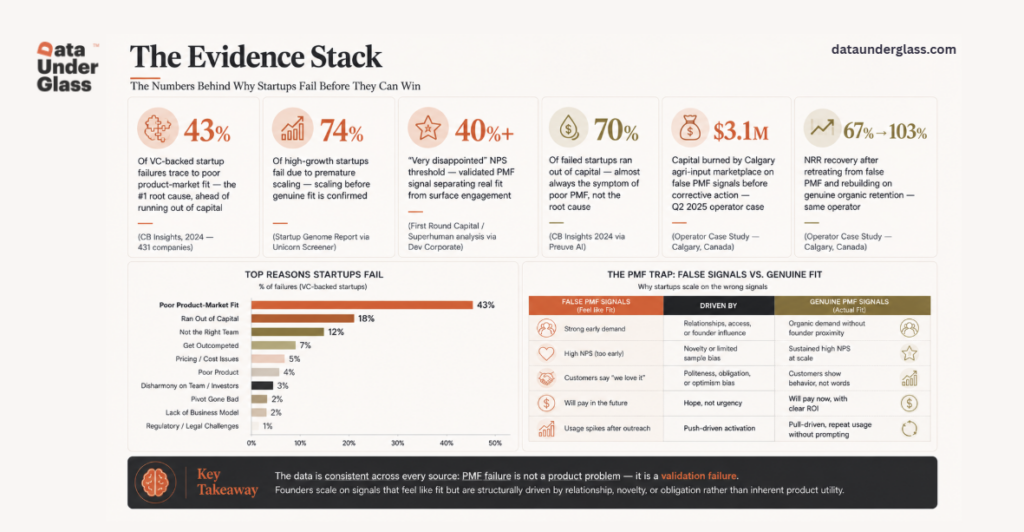
- 70%: Of failed startups ran out of capital—almost always the symptom of poor PMF, not the root cause (CB Insights 2024 via Preuve AI)
- $3.1M: Capital burned by Calgary agri-input marketplace on false PMF signals before corrective action—Q2 2025 operator case
- 67% → 103%: NRR recovery after retreating from false PMF and rebuilding on genuine organic retention—same operator
The data is consistent across every source: PMF failure is not a product problem—it is a validation failure. Founders scale on signals that feel like fit but are structurally driven by relationship, novelty, or obligation rather than inherent product utility.
Flagship Insight: The Five False PMF Signals
Early-stage companies misread five specific signal types as evidence of fit. Each one looks like momentum. None of them is.
1. Pilot Conversions from Network Customers
Pilots sourced through founder relationships engage out of social obligation. The conversion rate is real. The underlying demand signal is not. When the relationship expires, the account expires with it. The Calgary operator had 94% engagement and $340K GMV—from 3 accounts that would not renew. That is not fit; it is a social contract with an expiry date stamped on it.
2. High Gross Metrics Without Organic Pull
Engagement, sessions, and GMV tell you people showed up. They do not tell you why. A 0% organic referral rate is the signature of a product people use because they were asked—not because they would recommend it. In the Canada–Africa corridor, where informal referral networks drive a disproportionate share of enterprise discovery, the absence of organic referrals is a sharper signal than any conversion rate.
3. Testimonials Without Churn Data
A testimonial tells you a customer was satisfied at the moment they wrote it. A renewal tells you they found enough value to pay again. The Calgary operator had enthusiastic testimonials and 73% non-network churn. False PMF almost always presents this way—strong qualitative feedback alongside weak retention because early users are too polite or too obligated to say the product isn’t working.
4. Geographic Expansion Before Core Market Stability
Entering Kenya and Ghana before the Nigeria core had demonstrated organic pull and sustainable unit economics is a structural error that CB Insights explicitly identifies: 20 Series B+ companies in their dataset cited poor PMF as a primary failure cause—companies that raised on early traction that never widened into a real market. Multi-market expansion accelerates the burn rate of a false signal — it does not validate it.
5. Speed-to-Scale Without Organic Baseline
Hiring 14 people in a market where the organic referral rate is 0% does not build the company faster. It builds the liability faster. In African agricultural markets, where decision cycles are lengthened by informal stakeholder networks and multi-party contract validation, a 6-month pilot-to-contract validation period is the minimum baseline. Anything shorter is a guess, not a strategy.
The DUG PMF Validation Protocol
Stop relying on testimonials and network conversions. If you want to know whether you have real PMF, run this 90-day stress test against your non-network customer segment exclusively.
| Metric | Threshold for Real PMF | What failure looks like |
|---|---|---|
| Organic Acquisition | > 30% of total growth | Growth driven entirely by introductions and outbound |
| Monthly Churn (non-network) | < 5% | 73% churn among customers who didn’t know the founder |
| NPS (non-network only) | > 40 | High NPS among network customers who are too polite to score honestly |
| Organic Referral Rate | > 0% | 0% unprompted referrals—the Calgary operator’s breaking point signal |
If your growth disappears when you remove network customers from the analysis, you do not have PMF. You have a well-managed social obligation.
What’s Actually Working
1. The Non-Network Cohort Separation
Operators who achieve genuine PMF segment their customer base into network and non-network cohorts from day one. Every metric — churn, LTV, referral rate, average order value — is tracked separately. If the non-network cohort underperforms the network cohort by more than 30% on any key metric, the PMF signal is contaminated. The Calgary operator’s non-network average order value was 61% below pilot levels. That gap was visible from month two. Nobody looked.
2. The 90-Day Organic Validation Window
Before any growth capital is deployed, run a strict 90-day window in which all customer acquisition must come from organic or non-network sources. If you cannot generate 30% organic acquisition in 90 days without leaning on your personal network, the product does not yet have the inherent pull required to justify scale. The First Round Capital / Superhuman research confirms that companies which struggle to grow almost always fall below the 40% “very disappointed” NPS threshold — because the product isn’t yet a must-have for anyone outside the founder’s immediate circle.
3. African Market Calibration: The 6-Month Pilot Standard
In Nigerian, Kenyan, and Ghanaian enterprise markets, informal stakeholder networks, multi-party procurement approval, and relationship-first buying cultures extend the authentic decision cycle well beyond North American benchmarks. A 6-month pilot-to-contract validation period is your minimum baseline before declaring fit. A 3-month North American benchmark applied to a Lagos cooperative or a Nairobi agri-processor will systematically produce false positives. Budget the time, or budget the $3.1M.
Steal This: The PMF Reality Audit
1. The Network Removal Test: Audit your current customer base today. Flag every user acquired through a personal connection. Remove them from your core PMF metric analysis. Does your fit disappear? If your churn rate doubles and your organic referral rate hits zero—you have your answer.
2. The Referral Rate Check: Pull the last 90 days of new customer acquisitions. For each one, identify the exact source. What percentage arrived without being introduced by the founder or a team member? Below 30% means the product is not yet pulling on its own — and any capital deployed for scale is going into a leaky system.
3. The Churn Cohort Split: Separate non-network customers from network customers and run churn analysis on each independently. A gap of more than 20 percentage points between the two groups is the signature of relationship subsidy. The network cohort is masking the product’s inability to retain strangers.
4. The NPS Honesty Filter: Run your NPS survey exclusively among customers who had no prior relationship with the founding team before purchase. Responses from network customers are socially contaminated. The threshold that separates genuine fit from polite noise is 40% responding “very disappointed” if they could no longer use the product, validated by First Round Capital’s Superhuman analysis across multiple growth-stage companies.
Field Intelligence
Signal
- Implementing 90-day PMF stress tests against organic acquisition and non-network retention before declaring fit
- Separating network and non-network customer cohorts in all core metric reporting from day one
- Using 6-month pilot-to-contract validation periods in African enterprise markets before growth capital deployment
- Treating organic referral rate as the primary leading PMF indicator, not conversion rate
Noise
- Pilot engagement metrics and friendly customer testimonials used as primary PMF evidence
- Applying 3-month North American PMF benchmarks to Nigerian, Kenyan, or Ghanaian enterprise markets
- Scaling team headcount and geographic footprint before organic acquisition baseline is established
- Blending network and non-network customer data into a single PMF metric — hiding the signal in the average
The Bottom Line
Traction is not PMF. Traction is the result of your hustle. PMF is the result of your product’s inherent utility. If your best customers are people who like you, you haven’t validated a market—you’ve validated your address book.
The provocative reality: Founders who implement rigorous non-network validation before raising growth capital arrive at scale with a defensible organic growth engine. Those who don’t are watching $3.1M disappear into the gap between what a pilot looks like and what a market actually is.
The hard truth: If you remove your personal network from your customer list and your metrics collapse, you don’t have product-market fit—you have a very expensive social obligation running on venture capital.